PoE2 – Scaling & Mods

Scaling is an interesting thing, I’ve written a lot about the concepts in gaming. Most ARPGs tend to have a weird mix of them, where monsters appear linear but are actually exponential, and players appear linear but are actually logarithmic bumps. The math behind it generally results in you either feeling good or bad about your power level. You feel strong being a level 50 taking on level 1 mice, but feel week taking on a level 60 boss, right?

Ok, real hard tangent for a minute. Taxes are math. When you’re young, taxes are pretty simple. When you get older, taxes can get hard, man. There’s an actual profession for it! The goal of taxes remains simple enough, people pay their fair share for common services. Now, everyone has their own definition of fair, and that’s why the complex math exists. Your emotional reaction to fair has a major impact.

ARPGs use this model, where some content feels fair and others do not. Some encounters feel good, and others on the exact same map, feel punishing. Why? There are a couple reasons here, and they boil down to mechanics and math.

Mechanics

Enemies have their own methods of attacking you. Some burrow, some fly, some are melee, some are ranged. PoE has some rather insane enemy variety to parse, and they are generally visually distinct which helps. Mods though, mods will do you in. A monster with a hp/mana drain effect and can only be hit while being next to them is, for most players, an immortal enemy. Again, all the deadly ones have a very obvious visual clue.

Some events are more fun than others, mostly due to their mechanics. Having a ton of spawning enemies is generally manageable. Having multiple rares spawn at the same time – that is extra spicy. Breach, Expedition, and Rune events can cause this, with minimal warning. The net effect is that while you’re pushing maps there are certain events you will absolutely want to avoid, simply because the mechanics themselves are too volatile. Delirium certainly feels like hard mode if you get all the way to the boss and get a double spawn, as the difficulty in the map actually gets harder as you go!

Map bosses have their own amount of fun with generally a fair share of AE mechanic to avoid. With only a couple exceptions, there are few 1-hit-kill attacks so you are generally provided ample time to avoid a big hit. The effects of a given map will impact a battle, but this isn’t specific to the boss but all content in a map. Arguably, the harder a map, the easier the boss as you will have memorized the mechanics by that point. Except maybe the psycho gorilla. Screw that guy.

Major bosses are a different matter – these are either end-of-act repeats of bosses or new pinnacle bosses with absolutely punishing mechanics that will kill you. And then kill you again. But then you’ll get it! And then die again. (Noting that every death has you lose 10% xp, but not a level. Ideally only try these bosses when you just leveled up.)

Math

This is where PoE2 frankly does most people in. Your damage output and taken is under a complicated formula. Conceptually it is simple, but the practicality is much, much different. A minor thing, like +5 damage on a glove could have a few hundred damage impact in the end game. Uncapped resists are just, well, wild when you look at the actual impacts on numbers. And there are so many intertwining systems, it honestly feels like a math degree to work it all out.

In this space, hats off to frankly every other ARPG out there for having generally solved this issue. You can get to max difficulty in pretty much all of them without any help. PoE has a Solo-Self-Found (SSF) mode where you can’t trade. That should give you an idea of how much trading is core to the process of gearing. PoE2 has this mode as well, but has some controls to try and help here… back to a prior post on item drops.

The net effect is that by changing 1 piece of gear you will immediately feel the in-game effects. Making the correct choice as to which piece of gear to prioritize (99% of the time it’s your weapon) and what stats you want on it, well, that’s the true battle.

Finally a bit on the actual Waystone tiers. Maps start at 65 for tier 1 and go to 80 for tier 16. One level may not seem like much, but enemy stats scale with levels. There’s no damage penalty for a level difference, but the game expects you to be at a certain threshold – and item / mod drops are level based – so you will for sure feel a difference between tiers.

The net result is that difficulty in PoE2 is a combination of the Waystone tier, the mods on that Waystone/Tablet, the actual event within that map, and finally the RNG of enemy mods on any given enemy. That means the concept of fair at any given time fluctuates wildly. What an interesting model.
Path of Exiles 2 – Maps and More Maps

This lake has no bottoms.

A long-standing challenge with Path of Exile is that seasons build upon themselves. Most mechanics in a given season become baseline, so you have an ever growing list of balls to juggle the more seasons take place. Most games tend to put this in the DLC space, Grim Dawn certainly fits this bills. Others repackage content, like Diablo.

PoE2 released 0.5 recently and brought the Runes mechanic to the game. It’s a sort of RNG system where you get a choice of outcomes, fight some baddies, and get rewards. It also includes a Runic mechanic that gives access to a subset of different skills. Cool. It also keeps the Abyss, Vaal Temple, 2x Trials, Rogue Exiles, Breach, Expeditions, Rituals, Delirium, Shrines, Lockboxes, Pinnacle Bosses, and then of course the Atlas Map proper.

The Atlas is a gateway to all this content, an infinite set of procedurally generated map for you to clear. Each map can have one or more of the pieces of content present. You ‘juice’ these maps with a set of currency (Tributes & Tokens) to make them harder and more rewarding, and to potentially focus on a specific set of activities. You like running Abyss? You can narrow down that activity if you want.

As with everything PoE2, there’s a ton to unpack here and it will take a while. Credit though, GGG has figured out a way to more naturally direct you towards progress with clearer map markers and passive boosts. Make a choice as to what content you want to take on has no real bad answer, as all of them have their own rewards. This is so drastically different than say Diablo 4, where there’s zero reason to run the Pit once you have gems sorted out, or the wildly unbalanced Inferno runs. The further you get in D4, the less actual content there is to run and the harder it becomes to unlock said content. That is less the case with PoE2 as each activity drives the larger meta content forward.

Now, this doesn’t diminish at all the core challenges with PoE2. You still need a stupidly strong beating stick (with a specific set of stats) to be relevant, movement speed on boots is king, and it’s relatively easy to get lost in the skills + skill tree. On your own, building a viable character build, that’s gonna be quite tricky. The difference between viable and not is a friggin’ steep curve, if not a wall.

My major gripe with D4 is around War Plans, which is a sort of simplified Atlas passive tree. It takes quite a few hours to progress in War Plans, which is restricted per character and cannot be shared across groups. I still think this is such a weird decision. I do enjoy D4’s general lack of friction, a sort of fast-food of ARPGs. War Plans break that. PoE2, as with the original, doesn’t follow that mindset and your Atlas is shared across all characters. Kinda makes a big overall actually, as the leveling phase in this game is much longer than in D4.

0.5 Changes

I won’t go full hyperbole and say that everything has changed, but I will say enough has changed that the end game has general purpose and direction. The map has an interesting flow to it, where cardinal directions push you into specific types of content. There are quest markers that push you along those directions so that you get a general feel for what you enjoy. While the content is available pretty much anywhere, the randomness favors certain directions. And those directions provide more intrinsic rewards, primarily through points you can invest in the Atlas tree.

Now, PoE doing PoE things, very few systems are actually described with enough detail to make sense of it. While the direction and visual incentives make it sort of easier to navigate, the actual mechanics haven’t really been tweaked and remain somewhat obtuse. Breach for example, it seems straightforward to just kill as much as you can, but the reality is that passive points and targeting hands is the actual goal. Waystone ‘juicing’ has no real instructions, you just hope for the best while crafting. 0.5 is certainly better than before as it isn’t a blind buffet of options. It can still use some tweaks though, as it truly feels like its bursting at the seams with content in a small framework. Best example is that every 20 maps or so seems to have all possible content spawn within, which is a half dozen trips back to base to manage the drops.

The final point I do want to make for 0.5 is that there is substantially too many items that drop and no simple way to manage it. I have 2 tabs that are just for crafting things, and both are full. This is a QoL thing for sure, and frankly a massive barrier for new players to digest. There really isn’t a solution here as many of these items are specifically related to rolling a given modifier on a specific item (e.g. +cold dmg on gloves). On the one hand, great that you can sort of customize gear, but less great when you come to realize the amount of possible permutations on gear + mods and therefore the amount of crafting materials to cover the broader pieces.

The end game in PoE2 is the best it’s ever been, and the changes so far have filled in a lot of the confusing holes that were present before. It’s quite obvious people can spend a lot of time here trying to put all the pieces together and no two sessions ever feel the same. There’s still ample room for improvement here without necessarily simplifying any particular component, as the depth is the real selling feature. And aside from the final 2 story acts, this feels mechanically ‘complete’ as compared to other games in the genre. Still a good 6+ months before it truly launches, and if you haven’t already dived in, I would personally wait until the F2P launch actually occurs. And I say that solely because if you are not already playing, that learning all these systems likely would benefit from a couple QoL reviews.

Windrose – New Song

There’s a sort of familiarity within genres that we get used to. A point where devs kinda look at the mechanics and go, ‘yeah, we can’t really do better than this’. Survival games have you punching trees. You’ve always punched trees, you will always punch trees. Tree punching is where it’s at.

These foundational elements are important, as they mean you need less time designing a tutorial and balancing the basic elements. The comparison to a song is apt. Imagine making a new song with brand new instruments. Or making one that’s only drums. Sure, technically it’s a song, but I mean, is it really? These foundational bits allow for a stable base from which you can build new ideas.

Windrose generally keeps the foundations in place, though tweaks some bits. Harvesting material, mining, smelting, construction is all pretty much like you’d expect. You need a spawn location, you need a roof to place buildings, you need coal to make copper, you place extra buildings to unlock higher tiered crafting abilities.

Where it tweaks the model a tad is in the combat space, and I’d be hard pressed to argue this model works as I would have expected. Before I get to this, I want to remind people that there are difficulty sliders you can set when you are at the login screen. There are really no death penalties here except time to reach your corpse – your call how many corpse runs are too much.

Ground Combat

  • First, and importantly, you need food. That boosts your HP to manageable levels. If you don’t have food, a level 1 boar will kill you in 2 hits. Get food. And know that dying has you lose the food effect.
  • Related, have bandages for a HoT, and try to keep a pack of healing potions for tough spots. I use bandages all the time.
  • I do enjoy i-frame combat (dodging), where timing is key. I enjoy when there’s a difficulty to remember a pattern. That’s present here.
  • I also enjoy parry combat, where you can retaliate. That is also present here.
  • Dodging ‘red attacks’ is timing based, more like a parry in terms of timing. Charging boars from the jungle are likely to 1-shot you with no/poor food from this attack.
    • Some enemies (alpha wolves in particular) have moves that are insanely hard to dodge, with very odd hitboxes. Expect to die until you learn all the patterns.
  • Both of those systems require a particular level of fine tuning, and neither of them are designed for 1 vs many combat situations. The net effect is what I call mosquito fights, where you attack, then run like hell waiting for an opening, and repeat. The first boss is a major skill check on your ability to dodge, at least in solo play.
  • Ranged attacks are not very powerful, require gunpowder (which can’t be crafted in the first zone), and the combat materials stack extremely poorly. Think of it as an extra attack rather than a primary attack, and you’ll be ok.
  • All told, this gives one particular weapon a ridiculous advantage, the Rapier of a Thousand Cuts – which is in a buried chest right next to when you start the game. This thing applies a stacking DoT, which melts most enemies.

Ship Combat

  • In nearly all cases, your ship will be faster than any enemy. They’ll still get some potshots at you, but you can outrun them.
  • Repair Kits. These heal your ship, but reduce their value if you get damaged. You can also repair you ship for much less at your home warf.
  • Cannons. Upgrade them for more damage. When aiming, know there’s movement at play so at distance aim ahead of a ship and as close to the waterline as possible. With 3 canons, you want to run at 3/4 sail speed and try to get all 3 shots on cooldown. This is very similar to other games, nothing fancy.
  • Keel. Upgrade for slightly more armor. Eventually you’ll get enough faction for a rare version that allows you to heal while taking damage, and that one is worth maxing.
  • Naval Tactics (the book slot). Don’t worry about this for a while, til at least after the first boss.
  • Boarding Gear. Upgrade this to max. More in a sec.
  • Picking targets. Always take out the lowest level enemy possible first. And try to avoid going in circles. For 1vs5 fights, you need to strafe the entire group and learn to pick targets effectively.
  • Boarding. Unless there’s a chest icon above the enemy ship, don’t ever board. There’s no reward and the melee combat is likely to kill you. If there is a chest icon, YMMV. If your boarding gear is higher than the enemy level, the NPCs will do the job for you. If not, you’ll need a gun. If you think you’ll lose, summon your tiny raft, jump to it, then back to the ship and the boarding will reset and you can sink the enemy ship.
  • Eventually you get to craft a Brig, then a Frigate. They cost an absolute fortune.
  • Ship combat itself is fun in most times, and presents the best way to acquire money + faction rep items.

Exploration

Your starter island has pretty much everything you need to get to the first boss. The need to leave is based almost exclusively on exploration & quests. For that, you need a ship. And while on the ship, you want to press F to change the view. Look at the horizon for new islands. Quest markers will point you around the map, and it’s good to keep an eye on all islands along the path. Your ship opens up more of the map and can detect points of interest from a decent distance. The world map is substantially large. When you land, there are really two main options:

  • Exploration. Land on an island. Immediately craft a tent for a spawn point. Make sure you’re fed and have empty-ish bags. Explore the island and place tents near ? points. When the island is done, head to shore, board the ship and return home to port and empty your bags. If you die while exploring, it’s a judgment call if you want to feed yourself again. Taking on a half dozen pirates with a pair of musketeers… you are going to die again, no question about it.
  • Farming. If the island has points of interest that continually spawn items (hover over the point to see what spawns), you will place a Bell on the beach so you can easily return. Items (not chests) normally respawn after 3 in-game days. The only teleport restriction is having only 10 Bells placed, easy to manage.

Note that major points of interest have their own teleport locations. This includes all faction hubs, Tortuga, and boss locations.

If it isn’t terribly clear yet, this game has a very odd difficulty curve. It’s not ‘deathsquito’ level painful here, not even remotely close. But do get used to dying, a LOT, and having player skill much more than stats determine your level of progress. A trule palate cleanser after a binge of ARPGs.

Skill vs Stats

Brought to you by – one-hit kill mechanics!

Nearly all RPGs have statistics, used to math out the results of an event. Your perception to detect a trap, your agility to avoid a blow, your strength to deal damage. Simple in concept, and as D&D has proven, extremely complicated in execution. Dice wars are a thing folks.

For this particular post I wanted to explore the concept of skill vs stats. The typical JRPG has had a ‘Level 1’ challenge where a player tries to complete the game at the absolute lowest level possible, with the worst stats, and simply ‘gimmicks’ the game to completion. FFX has a notorious NSG (no sphere grid) challenge I’ve attempted that boils that down to the essence of cheese. On the one hand, games are math and math has a logical output, if you understand the formula. Rarely is random ever truly random with computers, and as such, players have found ways to tweak the math in their favor. Shaving the dice as it were. Conversely, there are games where you can simply stack the stats to a sufficient level that all math is irrelevant due to scaling, which is an end result of a power scale with no meaningful end. Again, JRPGs have exceled here, where the end game is some sort of uber challenge that makes the final boss look like a tissue in a rainstorm.

ARPGs are in this vein but have their own sauce. The mechanical pieces of the game usually have no upper limit in math, which allows for ‘god rolls’ and players pushing the hardest difficulty possible, with some measure of skill included. For the most part though, the events in the games are dictated by your ability to reach statistical thresholds to survive/defeat a particular event. If a boss is able to 1-shot you, then you need improved defense stats. If the battle takes forever, you need more attack stats. Mitigation and mechanics are sometimes present, such as ‘don’t stand in the fire’, but there comes a point where you can simply stat your way out of it, and face-tank the event.

Well, that’s mostly true. Some ARPGs do have situational mechanics that defy all stats and require you to pay attention. Some battles have timers that require you to perform specific steps before a game over. Some have 1 shot mechanics that require memorization + mobility to avoid. Some are just artificially challenging as it’s not content you’re actually meant to experience until other events take place (e.g. invulnerability phases). This effectively maintains the challenge of a given event regardless of the stats you have, which I will readily admit I am not a fan.

This is more due to design concepts than mechanics, or perhaps more accurately the player conditioning applied and reversals. ARPGs are meant to be near-infinite stat ladders, where a few more digits can move you to the next tier of the hamster wheel. There is no stat stick that prevents a 1-shot mechanic, and as such, this mechanic stops the momentum of the wheel in its entirety. There’s no flow, dude. This friction may be seen as interesting by some, but more of a nuisance by others.

Diablo 4 certainly has it’s fair share here, which is more of a frustration due to the visual cues not being clear when the screen is simply filled with FX. If your character has an aura for example, or a hydra on the ground, it’s entirely possible to not see any cue and just go poof. Which, fine, you won’t see at all if you can conversely 1-shot the boss and simply skip those mechanics. This adds some interesting decision points for players, as not all content at a given level is the same. Duriel, Andariel, and the Aspect all have the same loot pool. Duriel is dramatically easier than both the peers, so players will only really ever do that run. Heck, a nightmare (+15) version of Duriel is easier than a base level Lilith.

It’s funny in a way, this was a similar issue with WoW for years where raid markers were near impossible to detect and frankly was the core reason DBM was created, or why players simply turned off VFX in progressive raids. I don’t need to see my sword on fire, I need to see me not on fire.

I’m kind of curious as to how the next Diablo 4 DLC decides to tackle the difficulty curve of stats vs skills. I know there’s more splits in the difficulty levels planned, but the overall balance should be interesting. If it’s anything like the Diablo3 RoS expansion, then this should be quite eye opening. PoE2 still has no details on Patch 0.5… so will be interesting to see what comes from that.

The Diablo4 Hamster Wheel

Following on the ARPG itemization post, D4 has a ‘refined’ journey here after a few years of tweaking and 1 DLC in prod (another coming end of month). It would be fair to say that D4 has stumbled at multiple points as the seasonal changes are often significant tweaks to the model, rather than simply tweaks (as in D3). Most of this relates to how rewards are allocated for given activities, sometimes helltides are better, sometimes bosses, sometimes undercity runs. The community generally adapts quickly. This post therefore reflects Season 12. I’ll update this for later seasons.

Assuming you are a fresh level 60, there’s only one real measure of progress and that’s a sustainable clear rate in Torment 4 – the highest difficulty currently available. In order to reach this, you need better stats. To get better stats, you need to play the hamster wheel of content.

Paragon

These are meta levels that are shared on all characters in a realm, in a system that’s more akin to PoE in complexity. This means there are optimal builds, and you can reset it pretty easy. You’ll likely be 200 levels into this by T4 difficulty. Gaining levels is passive as you complete content. Meaning – don’t worry about it, worry about gear.

Equipment

There are 2 types of items to worry about – Legendary and Unique. Legendary items can roll a multitude of stats and can be significantly tweaked (more on that). Uniques have fixed stats and fixes bonuses that cannot be used on other equipment. About half of the gear for any given build will be uniques.

These items can also roll as Ancient (50 power stronger) and/or Bloodied (extra stat boosts if you kill many enemies in a sequences). T1 content generally requires a decent set of Legendary items. T2 the mix of Legendary and Unique. T3 needs more of it upgraded to Ancient versions. T4 has optimal stat rolls.

Item Tweaks

You can enchant an item to re-roll one stat to something you prefer, at increasing costs. You can imprint legendaries with different passives, yet another stat that gives flexibility. You can temper items to add a passive boost (like more fire damage). You can add sockets and gems for stat boosts, or with 2 sockets, add runewords for skills that activate in certain conditions. And you can masterwork gear, improving it’s level by 25.

As a melee user, you likely want pants with Strength, Armor, Hit Points, and Critical Strike chance. You likely want a boost to whirlwind too. And slot runewords. That’s a lot of rolls that need to go your way. In D4, you only need 3 of those 4 initial stat rolls and can modify the item for all the others, and for dirt cheap as well!

Across 10 or so items, this makes a huge difference.

Acquiring Gear

This is the core of the game, right? All these activities have a difficulty level that is similar, though Boss Lairs can be a notch higher.

  • Dungeons: Don’t do them, plain and simple.
  • Nightmare Dungeons: You’ll randomly get a key to ‘upgrade’ a dungeon to a harder version. In season 12, I’d suggest you don’t run these.
  • Slaughterhouse: Random key drops where you play as the Butcher. This is ‘fun mode’ and provide no meaningful rewards outside of the season journey.
  • Infernal Runs: Increasing waves of difficulty (4, 6, 8, or 10) that give crafting rewards while leveling, and have a couple chests at the end. Outside of the seasonal journey goals, I would avoid this.
  • Helltides: An area of the map has super spawn modes that drop cinders allowing you to open chests for random rewards. Useful all the way until Torment 1.
  • Legion Events: Every 30 minutes or so, a multi-stage event with decent enough drops for the time invested.
  • World Boss: Much longer spawns, only do it once a week. Not really worth the effort.
  • Boss Lairs: You can access this any time but to open the chest you need Lair components. Bosses have much higher odds of dropping specific uniques. Mythical uniques (super rare) come from uber versions, and in season 12, Duriel is miles away from any other option here to farm. Bosses are generally harder than dungeons.
  • Whispers: Completing a set of random activities gives you points, which you can redeem for loot chests. Don’t focus on it, but consider it when faced with multiple content options.
  • The Pit: These are essentially D3 greater rifts, meant solely to upgrade glyphs used in the Paragon system. Get your 5 main glyphs to level 15 quickly. Level 46 is needed to get to get past T3. I would not recommend pushing past 46 until you can comfortably do T4 content.
  • Undercity: Similar to the Pit in structure, but you can target rewards with Tributes. Useful to get more runes, Obducite, or legendaries. Generally, this is the activity that gives the most rewards per minute of activity.

Bloodied Dungeons, Infernal Runs, and Boss Lairs add +15 difficulty to the content you are in, which is a bit more than a single Torment level of difficulty. This means, if you use a key at T2, the content will be a bit more difficult than T3. If you want to use these keys, I suggest you drop the difficulty level down by 1. Bloodied Boss Lairs are extremely rewarding.

Gambling (Safety Net)

By doing the various bits of activity, you’ll also be rewarded with other currency you can use to get more gear in town.

  • Pale Marks. You get these from using mercenaries, can’t really find the benefit here.
  • Obols. There’s a cap on how many you can carry and you get this through a ton of activities, though mostly on the main map. One of the best ways to get your initial level 60 gear.
  • Fresh Meat. Very similar to Obols, allows you to get Bloodied gear. Slaughterhouses give a lot, and bloodied lair bosses give the most by far.
  • Butcher boxes. By chaining together multiple kills, you get points, which give you item boxes that drop a ton of loot and keys. You likely won’t even notice it as you need to manually collect it from the seasonal board, which is unfortunate given the rewards they hand out.

Dark Citadel

Adding this sort of footnote regarding the only mandatory grouping content in the game. Rewards are the same as other content, and the amount you get is determined by clear speed, which will be slower than all other options. There are cosmetics here, but they haven’t changed since the feature was released. The group finder is rudimentary, so your mileage may vary. This isn’t ‘brrrr-mode’, there are actual combat mechanics that need to be performed to avoid a wipe, so mindless play doesn’t work.

Personally, I think MMO-mechanics in an ARPG are not a terribly good use of resources without some sort of meta-incentive. Guilds in D4 are currently just group chats, so maybe there’s something that could be done here instead. For now, I’d avoid the content.

Warhammer40K – Rogue Trader

As per the prior post, I don’t tend to pick up ‘premium’ games at launch. In many cases I end up waiting for a promised DLC to launch, as that often comes with a major balance patch. Think about Diablo3 pre- and post-RoS. Completely different games. Rogue Trader fits this model.

It’s a CRPG, which more or less means it’s like Baldur’s Gate. You control a party of characters who go on a very long set of quests, see stats go up, and make character defining decisions, almost always in an isometric-type view. BG3 pretty much perfected this model and everyone has been trying to find a niche along that path.

Now, Warhammer40K comes with baggage. It’s a world of constant war, where everyone is a shade of evil. If you look at the D&D alignment model, there is no good, there is no neutral. The Imperium (where you reside) is lawful evil. Anyone who says otherwise doesn’t understand satire. You play the titular Rogue Trader, a sort of vanguard to the imperium, conquering newly discovered planets, and building a financial empire. If you see it, it’s yours. Thankfully, no spreadsheets to manage here. Along the way you’ll collect a slew of party NPCs that fit various classes and backgrounds. Deluded space wizards, gun toting priests, deranged blood worshipers, and so on. You start off inheriting a part of the galaxy and need to stabilize it. Along the way, ‘bad stuff happens’. You can be dogmatic (be lawful evil), heretical (chaotic evil with space madness), or an iconoclast (which is frankly more pragmatic than good). Now, CRPGs in general prefer an iconoclast approach and first time players are going to see more here. Heretical is hard mode. Dogmatic makes sense about 20% of the time (e.g. purging a planet that’s converted to madness), and dumb the rest of the time (e.g. an ally offers you their services for free and you shoot them instead). The writing is thematically aligned to 40K, very lengthy and full of complicated terms. It works.

Quickly, the companions here are well done and thematically resonant. They have very little interaction between them, but their individual perspectives and side quests are all quite interesting. Who you bring along on the journey is personal choice, unless you’re on the hardest difficulty.

Mechanically, the combat is a bit of XCOM (with action points + cover) and BG with various skills. It’s often your team of 6 against a dozen or more enemies. AE attacks and multiple single target attacks per turn are key. Generally, this works well. More in a bit, but there reaches a point where compounding levels and skills make you effectively run in god-mode with some crazy OP builds. It can get a bit much and overly complicated, but it works.

Inventory is weird. Still trying to make sense of any of it. Your bag will be filled with generic items that have a 2-5% stat difference… but they have a very big integration with skills. Heavy Bolters may deal less damage on paper, but with the proper build they are infinite bullet machines. Keeping track of all of this is complicated, not to mention actually finding items that fit a build. YMMV.

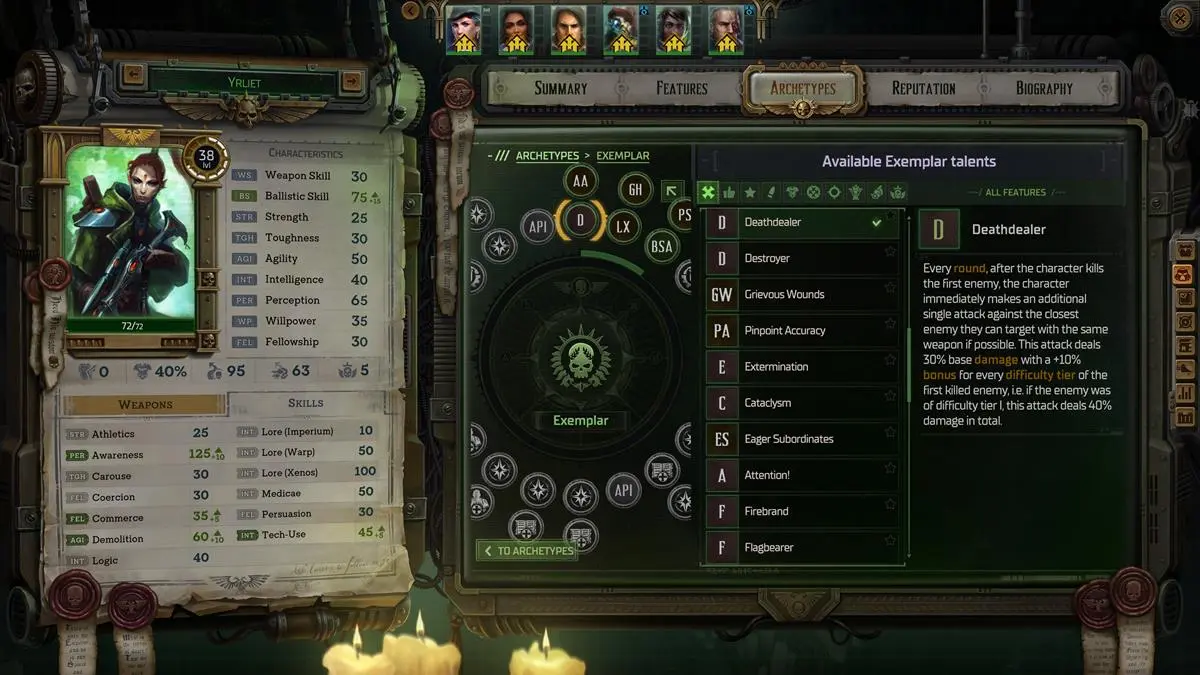
The stats and builds though, that is a friggin’ mess. Every level you’re given a set of options, often 30 or so, that you can select from in a list. A list! You can’t easily see dependencies or syngergies, and each one of them practically requires you to scroll to read the definitions. On the one hand, congratulations on having so many skill options! On the other, you can see how this is practically impossible to balance. I keep thinking of Path of Exile’s skill tree and build options, it’s just so much. Min-maxers will love this, but it is absolutely a challenge in terms of broader appeal.

Stat geeks rejoice! Note the scrollbar on the list of talents.

Side note, you remember the D&D issue with quadratic growth for mages? In that a warrior hit very hard and was sturdy for a few levels while a mage was a wet tissue, and then they acquired a few tier 4 spells and turned on god mode. That model is here too. Melee is dramatically limited in damage and movement by the mid-point. Ranged AE attackers can clear an entire field with multiple tools and turns. I mean, I still love the bladedancer cause they can decimate 5+ weaker enemies in a single turn and it looks damn cool. I can also shoot an arc rifle at the same group and AE them all for triple the damage, then get another free shot for the next group on the other half of the map.

There are a multitude of other systems in here that work at various levels. Space combat is meh. Space exploration has overly complicated (but absolutely nails the thematic pieces). Merchants are amazing, where if you have reputation with them and a given ‘profit factor’ that measures overall wealth, you simply by the thing. I really like this model.

Is this game better than BG3? No, and it’s not trying to be which is actually refreshing. It can easily take you 100 hours to get through a single playthrough, and very few games ever offer that these days. Replay value is iffy, as it’s less about build diversity than story choices. Well, I guess that particular statement is a matter of perspective with so many skills to choose from. Still, the question boils down to…

Is it any good, and is there value? An absolutely emphatic yes to the first part, the game is quite good. It has quirks and leans heavily into the theme, and frankly may be the ‘truest’ 40K game out there as a result. Value is subjective, but consider this – it’s 100hrs of content, with voice acting and quality writing throughout, it has meaty DLC, and is on a banger sale. I think there’s a lot of value, and I am rather picky on these sort of things.

Obsidian & Sales Targets

Not often I comment on news, but interesting article all the same. Avowed + Outer Worlds 2 didn’t meet sales targets. The PoE setting will continue but not likely to see Outer Worlds do the same. Which makes me ponder, why?

Avowed

I liked this game as it delivered a ton on nice beats in a decent IP. It had a fair chunk of accolades, available on a bunch of platforms, and had a really good post-launch buzz. It had a month’s head start on Clair Obscur. It peaked at 20,000 on SteamDB, which is slightly lower than PoE2. It was priced as a sort of premium game. Maybe the targets were too high?

Outer Worlds 2

This game is still on my wishlist, and frankly, it launched in the mess of other games that took my attention. There wasn’t much buzz here, at least as compared to the first game. You could get the first game, plus all DLC (Spacer’s Choice) for a damn good deal. It peaked at the same level as the original, which is the same as the other one. The price point though, what the flying fart?

Clair Obscur

This game was priced at 60% of Outer Worlds 2, and 40% of Avowed. It peaked at 7x the amount of both of the others. It was also, quite clearly, better than the others.

Game Industry

Over the past 2 years, about 30% of the US game industry has seen layoffs. That is a wild statistic. Sure, there’s the post-pandemic slump, but there are other factors. Sources of funds have dried up. Game companies are spending way too long making games, with less meaningful returns. Gamers are primarily spending their times in the same 10 game today as they did for the past 3 years (Roblox + Fortnite top that list). The lower end of gaming is chock full of slop that can’t be triaged (50 games launch each day on Steam), and the middle tier has to really do something amazing to get any buzz going. And you know, the whole “everything is more expensive and I need to chose between food and games” thing going on.

Point being, the market is saturated and there’s a limit to how much anything can actually sell in the current climate.

Steam

This is an important factor, one that has impacted the general psyche of gamers. Steam has a wishlist function and nearly every game goes on sale at some point. Some publishers will drop their price by 30% or more within a month (looking at you Ubisoft!), and very few games launch nowdays in a functional state. You are almost always better off waiting a week for a major kitchen sink patch before diving in.

The only reason to buy something now is a sense of FOMO, which is insanely hard to predict. On top of it, that FOMO has to compensate for the price of admission. For every Elden Ring, there are hundreds of other premium games with much less to offer.

Value

Which is the ultimate factor in any buying decision, which is arguably mostly perception. Sure, you can math this out on the aggregate, manage some trends, get the buzz, and ride a sweet spot that lasts a few days or weeks. My persona preference here is somewhat straightforward, and related to the relationship between price and content.

  • $5 – Generally not much thought here, it needs some decent reviews and be between 2-10 hours of stuff.
  • $10 – This is generally reserved for EA games, and in areas I have a gaming interest.
  • $20 – My personal sweet spot, anything that has decent reviews and can keep me entertained for about 20 hours.
  • $40 – This is reserved for AAA games on sale, so I tend to only spend this during the winter + summer sales.
  • $60+ – Extremely rare that I will spend this much on a game, it has to be near perfect or a game I know I will devour. Clair Obscur for sure here. Monster Hunter Wilds too. Not much else!

I don’t think that Obsidian necessarily made a mistake here, their targets are clearly from Microsoft corporate who can’t seem to figure much out of late. Avowed is a solid game, Outer Worlds 2 seems to be as well. Neither are priced at a point where the perceived value is high enough to generate enough sales to meet some exec’s target. I’m hopeful some level of sanity gets applied here and a more realistic approach is used instead.

In the simplest of statements – make games that cost less.

StarRupture – Base Building

The core of any factory game is, well, building a factory. StarRupture tweaks the model a bit.

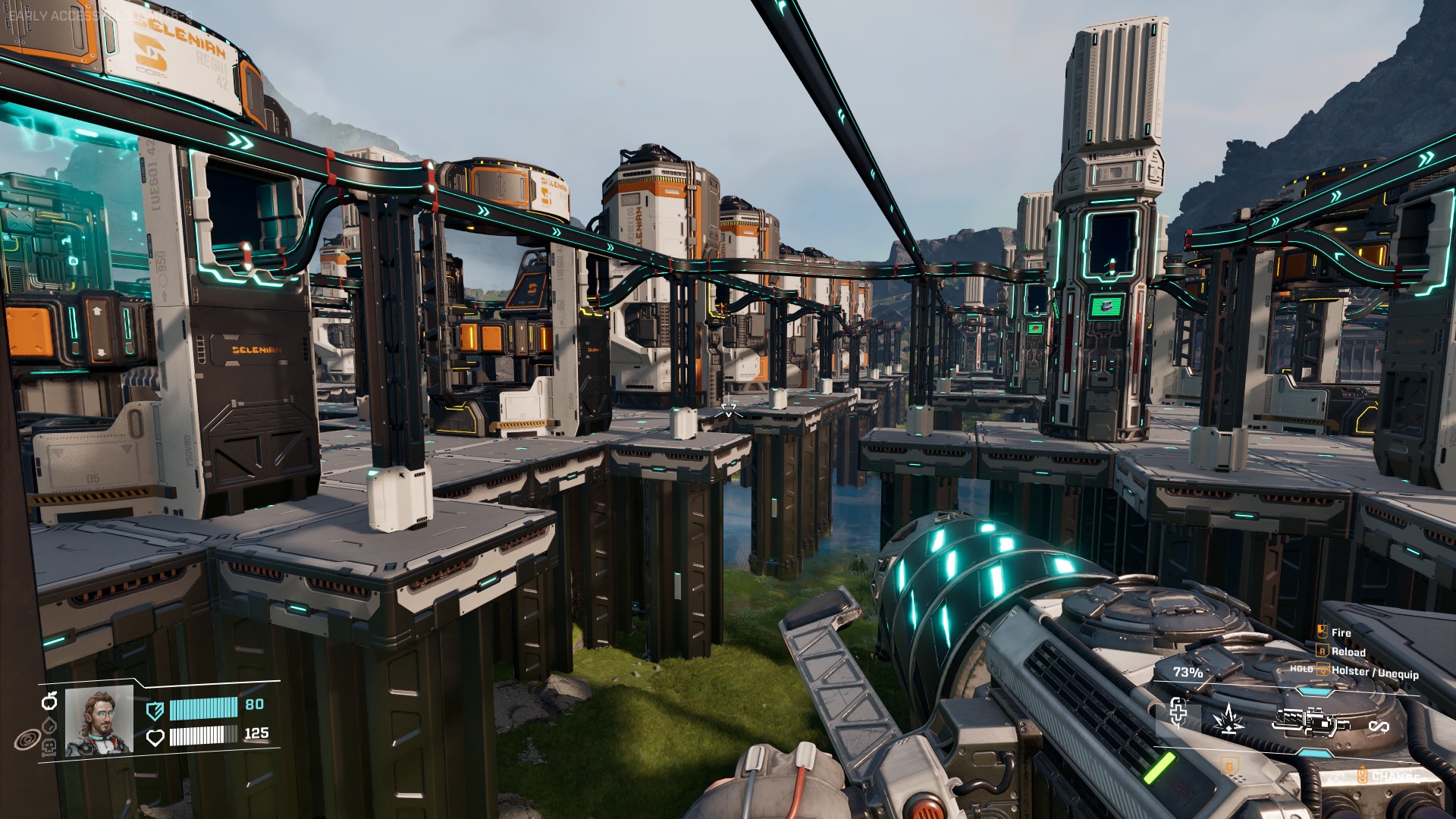
Material to build a base is extremely simple. It’s a single item type, super easy to transport. If Satisfactory had this, it would be a 10/10 game for me.

Placing a building requires you to be consistent with the Z axis (height) and cannot float in the air (stability). This is the only factory game I know of with this restriction, and is a challenge I’ll explain later. Basically, this limitation restricts any creativity or mega bases.

Each base starts with a Base Core. It allows building in a square radius, in particular allowing mining buildings to be placed. It also has a max amount of building points that enables protection from the hourly fire waves. You can upgrade the core, but doing so triggers continual enemy waves, which have poor mechanics at this time. So, level 1 it is.

You can also build habitats, which protect you from fire waves, give a respawn point, allow personal crafting + research, and a few other bits. Easy to build, easy to stack. These are needed for exploration, acting as save points.

Each base needs power. Solar to start, and then wind later. Set it and forget it, which makes it a pointless mechanic currently. I’m sure it will change.

Right, now to the actual buildings.

  • Smelters do what you think. They refine basic material. Simple ratios, standard output.
  • Fabricators allow up to 2 inputs and make basic material. Furnaces allow 3, Mega Press allow 4.
  • You’ll want storage buffers present, they are small enough in footprint.
  • Cargo dispatchers send things to cargo receivers. Build the receiver first. Throughput here isn’t spectacular, but it works.
  • Orbital Launchers send things to space in order to progress in content. Think simpler space elevators. It works well.

Rails though, rails are something else. They work in 3D and they clip, meaning they cannot overlap. There are 2 ranks currently, 120 & 240 items a minute. They are directional and can loop onto themselves. Importantly, the work on a pull mechanic, meaning they only have content on them if a building requires it. If rails are saturated (as you would with belts), you have some serious issues to work out.

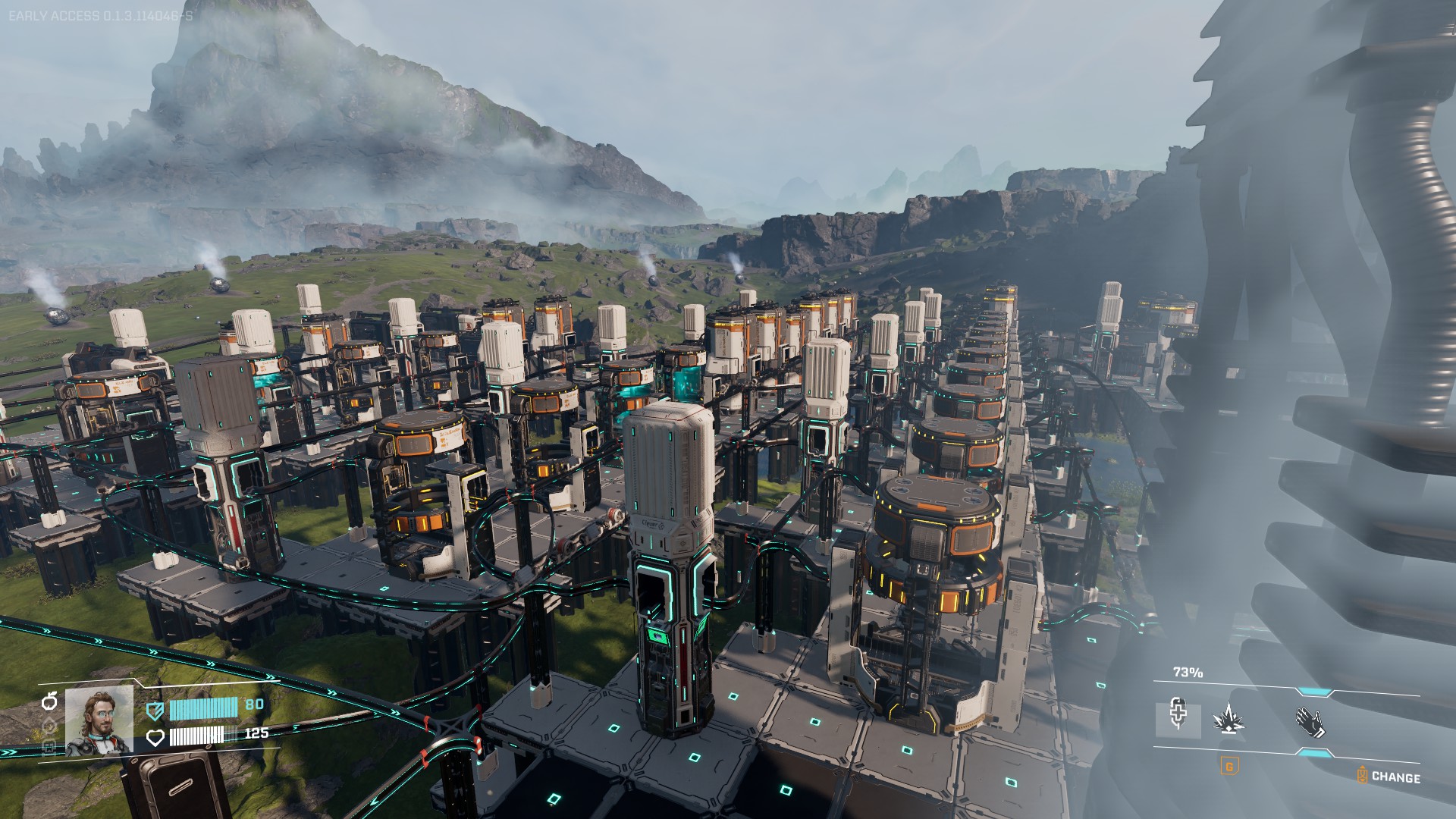
An attempt at a clean base.

Mega Base vs Mini Base

Scaling a base requires two things. Space to build and modularity (for re-use). Blueprints only add speed to the building process.

StarRupture doesn’t provide space, both due to the world terrain and base core limits. Oh, you can build a dedicated base to a level 8 item, but not to 2 of them.

Modularity is the next bit, in that a template needs to be applied. The issue here is rails. If you build a single rail to transport what you need (sort of a sushi belt), it will either get jammed with other requests, of generate a pile of spaghetti. If you build dedicated rails per input, for sure you are going to have clipping issues. 4 rails into a mega press… that takes up a crazy amount of space to build and requires so much clicking to make the vertical portion work.

Recall that in factory games add compounding amount of material requirements per level. Level 1 may need 10 things, level 8 requires 1,000. That means bigger factories. The end result is that you’re much better off building bases that are dedicated to level 6 items, which can be relatively compact. The challenge then is about inputs and outputs.

Ideally you use cargo shipping. It works well for advanced items, not so much for basic material (except helium, you need this for helium).

Sushi rails work at low volume.

This model works well enough up to the world engine. Looking at the item tree past that… what seems to be the result is a massive amount of drones shipping material across the map. Curious how this work long term.

StarRupture – Part 2

A bit further in. There appear to be 11 tiers currently, though only 8 are needed to reach the World Engine and the “end” of this version’s content. That’s about 20 hours or so.

A set of quick thoughts here, as there’s a sort of mixed bag train of thoughts.

The Good

  • This is early access and the systems are generally simplified. It makes little sense to add complexity now, get a solid foundation first.
  • The buildings + flow are a reasonable size and there aren’t 2 dozen of them. Effectively, you have 1 building per number of inputs, which is extremely nice to see.
  • The world itself looks and feels great. Exploration is rewarding. The pre/post flare world changes are also solid.
  • Material requirements for building are simplified, which is amazing! Imagine is Satisfactory didn’t require you to have 13 different items to build 1 thing, that’s here. It allows for base building anywhere with relative ease.
  • There are only a few raw material types to build with – effectively iron, copper, clay and helium for a large portion. You’re not stuck with super complicate spaghetti trains.
  • The movement + combat mechanics are generally responsive. You can double jump (2xspace) and dodge (left alt), which are not explained but essential for survival.
  • Building extended bases is relatively easy. A shield tower costs peanuts, and it’s dirt cheap to build a shelter with 2 clicks.
  • I like the idea of LEM (slot-in stat boosts), but the implementation feels wonky. The only ones that seem to matter now are +stamina. Would be neat to see this expanded.

The So-so

  • Base defence is interesting as an idea, but poorly executed. I strongly recommend never upgrading a base as that causes regular waves of attacks.
  • Moving items between bases becomes a requirement with helium. The tools to do so (cargo drones) can only be setup on the launch side, but need a target built ahead of time. This should be configurable from either end.
  • Enemy spawns are annoying as the world layout breaks your line of sight but not theirs. Very annoying near the world engine where multiple ranged enemies will attack you and no real ability to respond.
  • World traversal takes too long, and if you trigger enemies, they follow you for way too long. +Movement items are needed.
  • Rails (a version of belts) can get wonky, requiring a restart. I like the concept of a pull mechanic… more on that in a bit.
  • Base construction has a high dependency on the Z plane (vertical), in that it needs to touch the ground. If you’ve played Valheim where buildings fall apart if not on a solid foundation, see that same thing here. The concept is sound, but the tools present should allow you to build sufficient supports. Not the case. Which means very weird factory layouts.
  • Collecting recipes requires significant exploration. There map is a sort of L shape and you start in the bottom left. There are duplicate recipes in either direction, but actually finding those recipes feels more like luck. I don’t mind the exploration, but would be nice to have a sort of hot/cold mini game to pinpoint the ones you want.
  • Further to this, the only purpose of exploration is for a dozen or so recipes.
  • While I don’t mind the size of weapon clips (for reloads), the ammo stacks are too small. 300 currently, should be 1000.
  • Dying has you lose your weapon and items. If you died it’s 99% because of enemies and likely you will die during a corpse run. Creating a new weapon + ammo means you need to create storage boxes at every base. Meh.

The Bad

  • Base defence in general when facing repetitive waves of enemies. I have a large dislike for PvE in my factory games, it disrupts the zen. I can manage it to a degree if the automated tools present can be configured to manage that threat. For now, I would hope they add a toggle to remove wave spawns until the defensive options are overhauled.
  • Hunger / Thirst mechanics just don’t work here. They aren’t meaningful, the items you can produce are all worse than their raw ingredients, and provide no added game context. Having 12 different food items as raw ingredients counters the good of the game (simple).
  • The amount of items that can be crafted as you progress is, well, concerning due to factory design challenges.

There is a ton of cool stuff here, and it’s different enough to bring some interesting ideas to the table. It addresses a ton of the issues present in the genre, both with simplicity and continual goals to work on. Tons of potential here.

TR-49

I have a penchant for puzzle games, especially those that focus on deduction. TR-49 is from inkle, the same devs behind Heaven’s Vault. Both focus on language as the key puzzle component.

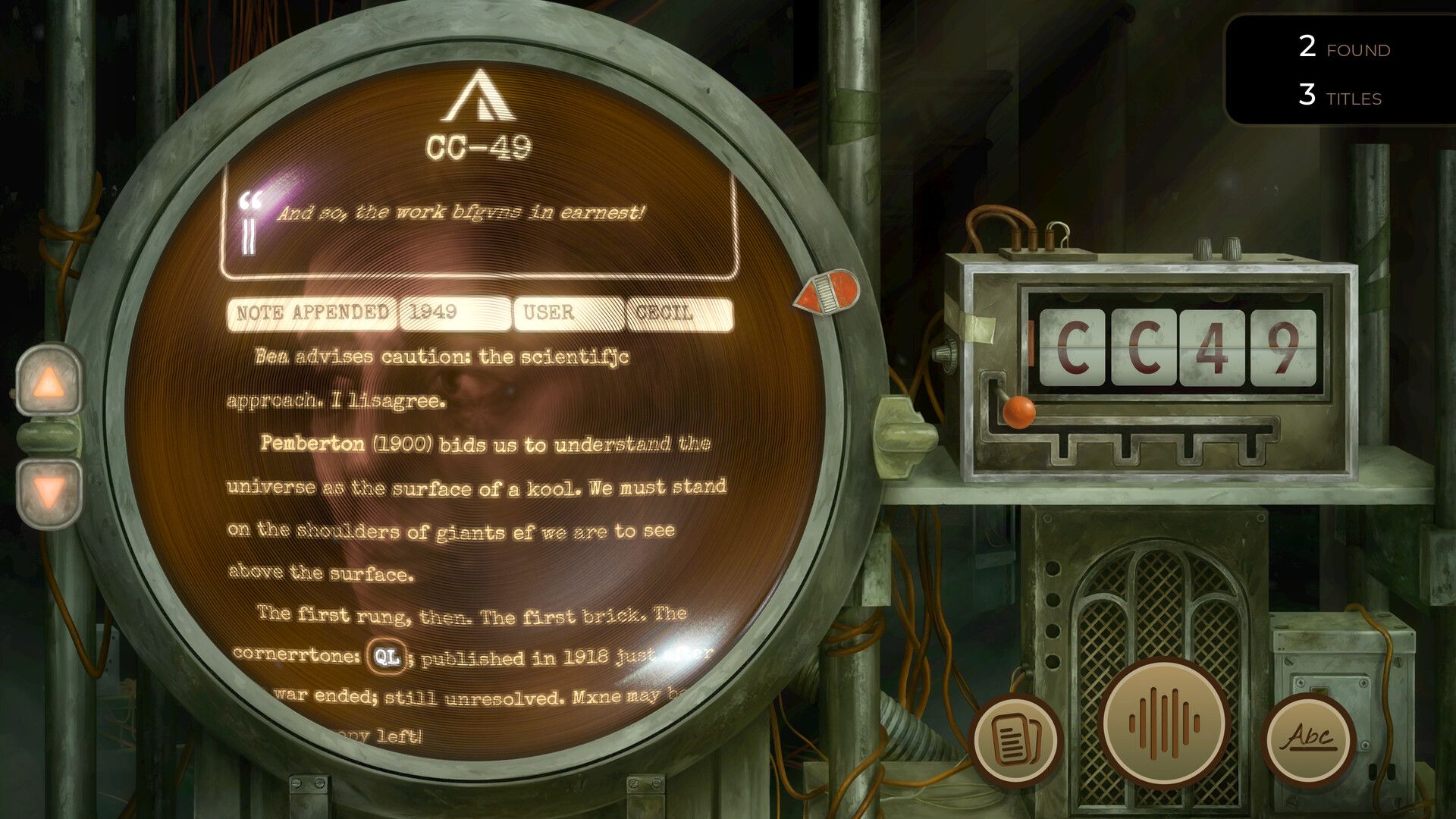
The principle interface is above. You have text on the left, and a code on the right. Through combinations of XX-## you navigate through what’s effectively a broken wikipedia, trying to restore the links. The main goal of the game is to wipe a particular record, and depending on your choice, there are multiple endings.

There are some automated note taking tools that help you deduce some pieces together, and milestones that let you know if you’ve hit a particular point. That adds a sort of boundary on the puzzle, which is key when you are presented with seemingly infinite options.

Each set of coordinates follows a particular pattern, which can be used to infer other links. The format always follows a XX=object and ##=date structure, it’s how they are intertwined that matters. The text itself may present something like ‘6 years before their death’, which gives a ## pivot for the same object. You can brute force the ## portion as it’s 100 choices if you’ve found an object code. There are other object codes that are used once, or coordinates that act for separate purposes.

While you’re solving this, there’s ongoing dialogue for the setting. It’s a weird setting and one that is best experienced fresh as it tightly bound to the multiple endings. This does add a lot of voice acting, where you will want to play with headphones in order to isolate the sound and truly focus on the puzzles.

The total journey isn’t exceptionally long, maybe 6 hours, but it is quite fulfilling. Well worth the purchase if you’re into this style of game, of which I am a HUGE fan.