Achievements in games have certainly grown into their own thing. Some games reward you for booting it up, others for finding a ping pong ball in an ocean. Your mileage may vary here.
What achievements also provide is a sort of meta evaluation of a game’s quality. As many provide an achievement for completing a tutorial as well as completing the final mission, you get a sort of metric as to how many people bought, played, and completed a game. Now, obviously you won’t get the actual number of players, but you will get an indication on stickiness. That is, a game’s ability to keep you playing.
This is the tutorial achievement for Star Wars Outlaws. 61% of players who bought the game, completed the tutorial.
This is for 007 First Light’s final mission. 54% of players completed the game.
This is Control Resonant’s tutorial achievement (97%). Without spoiling, the last boss achievement is at 15%.
I get that people buy games on sale and it stays stuck in the library for a while. Devs generally want larger purchase volumes, where long-term stick is more related to micro-transactions & DLC (excepting indie developers who want word of mouth). Call of Duty only wants you to stick around to sell you cosmetics after all. It is however a fascinating set of metrics to see where players simply drop off from a game. Control Resonant has an absolutely massive drop off right after the first zone, a point I personally found confusing in-game. That’s honestly too bad, cause that game absolutely rocks.
Other games simply never stick the initial landing, creating a hard bounce for new players. MMOs all have this issue after a while, but other games? Outer Worlds 2 has 90% hitting the tutorial and drops to 45% for completing it. From there, it drops to 20% for completing the game, meaning if you made it through the first planet, you’d stick til the end.
I’m fairly certain that these types of metrics are a big deal for the bean counters in the AAA space too, especially when it comes to sequel-itis. If players bounced in one area but stuck in another, you’re likely to see more of that in the next version *cough* Ubisoft *cough*.
I like stories from numbers. You can interpret a lot, and try to match up to the media lines companies put out. Plus for most of us, if you’ve actually bought a game, you should probably play it.
Unfortunate but not unexpected news today that BioWare is being shut down. They were the reason we have western RPGs, with absolute massive hits like Mass Effect and Dragon Age. Importantly, they also launched Baldur’s Gate, Jade Empire, and KOTOR.
There are many key points along the years that have been drained for clicks. The departure of Ray & Greg. EA’s meddling with KOTOR. Heck, EA’s meddling in almost everything past 2015! And EA’s final meddle is this cut.
For the good parts, for the clear vision of BioWare RPGs, we must give credit. They managed to fit complex stories that were character driven, with multiple paths, using a semi-modern platform. BG2 was a right miracle and a game I played for nearly 15 years. Mass Effect was revolutionary as a combat RPG. Everyone wanted to be a meatbag. Choices mattered in these games, and you actually felt like you were impacting the story to it’s end, giving you some measure of replayability. I played Dragon Age Origins all sorts of ways, just to tease out all the nooks and crannies for side quests. How many games actually allow you to take out the final bad guy through dialogue?
But let’s also be honest. BioWare died a long time ago, and EA was simply using the label to try to make money. This way, we’ll have the memories (and the games!) that frankly built the modern RPG. Hopefully all these workers can find meaningful work where they are valued. Best of luck!
While I read voraciously every day, I rarely post about any particular item. I was recommended The Phoenix Project from a work colleague and gave it a go. It’s a sort of sequel to the Unicorn project. The subject matter is ultra specific though, IT DevOps is not for everyone and has a ridiculous amount of jargon to sort through. The logic applied here is more important than the specifics. More accurately, these two books juggle the balance between the day to day portions of work, and how properly focused management practices can optimize that work to find a balance across profitability, employee satisfaction, and productivity.
In the gaming space, you should find some absolutely clear links to the
Concept #1 – Constraints& Bottlenecks
All production chains have constraints and bottlenecks. Identifying and remediating them is the only way to improve productivity. Any other improvements are only window dressing, as they eventually will encounter the restrictions. Sometimes this is tool related (like a machine that can only do 3 things an hour), sometimes this is people related (a single trained person to do the work). There are a bunch of ways to address this, like getting more / better tools, or changing the process to bypass the bottleneck.
Think of creating a late game item, your bottleneck could be anywhere in the production chain and you need to have good metrics to ensure you’re creating enough material to supply. Often times this happens when you run out of power to put more buildings down.
Concept #2 – Prioritization Is Essential
Few organizations actually understand what prioritization means. It’s more than just putting things in order to do, it’s about drawing a line on things you are unable to do. Less about saying ‘no’ and more about saying ‘not now’. This particular management point has the largest impact on employee satisfaction, as any single person allocated 90% or more work has no flexibility for more work. When the process is saturated, you cannot add MORE to the queue, it will just sit.
Think of belt saturation at the start/mid point of any factory. Eventually you’ll reach a point where you need to make a choice on what needs to be produced first. Heat on Aquilo is the only priority, nothing else works until you have that set up.
Concept #3 – Work Types
This is more specific to IT DevOps but the concept of distinct work packages is also core to optimization. There are business projects, IT projects, planned changes, and unplanned work. The first is what drives your business and clients. The second is what drives internal improvements. The third is how to manage the specific changes so that they don’t cause other issues. The fourth is everything else that suddenly pops out!
Using Factorio here, a business project would be launching a rocket to a new planet, requiring a lot of planning to get all the pieces ready. An IT project is building a power plant once you land on a planet, as you need that to get the other pieces going. A planned change is when you upgrade production chains, like moving from Assemblers to Electromagnetic Plants – this often causes issues in other production chains. Unplanned work is when stuff goes sideways. Like a biter attack that gets through your defences, or a spaceship that gets hit and loses the ability to produce ammo.
Real World
The concepts above apply to a bunch of real world domains, and all relate to awareness and decision making. You need to know there’s a problem, the actual problem, and then think of how any fix to that problem can be resolved without creating another one.
Maybe you notice your drain isn’t working the way it normally should. Is the issue with the P-trap, the main drain, or the main outlet? If none of those terms make any sense, then you need to find someone who can help you with it.
Maybe you want to plan a trip to a sunny destination, and realize that the cost is way more than expected. Do you change your plans? Do you prioritize your budget? Do you put in extra time/effort to get more money?
Maybe you plan to host a family BBQ and while you have more than enough food, the BBQ itself can only get food out to feed 5 at a time? Do you get a new BBQ? Do you change the menu to use less of it? Do you use an oven to help? Do you borrow your neighbour’s? Do you move towards a potluck where stuff is brought in cooked?
Most of us do this naturally and don’t really think about it, though often that’s due to familiarity with a domain of work. A bricklayer knows that they need to keep a set of material on hand and can only have so much mortar ready before it can’t be set. They may not have the same approach towards gardening, where plant spacing / shadows impacts overall growth. But the ideas are similar, right? A gardener gets their seedlings ready and at hand, with tools nearby. They have soil treatments & water at hand to ensure each has the best chance of growth.
I’m not saying everything needs to be treated this way. Random stuff is sometimes a lot of fun! Overplanning can drain the fun of any activity too! It is however a very effective way to manage stress levels, and giving yourself enough flex for any unplanned adventures. If every hour of your day is booked solid, when do you have time to be spontaneous or just enjoy life?
This is a very long winded review of a book that actually goes much farther than its material. There’s a lot of confirmation bias here, as it’s the way I’ve generally run my own life for nearly 30 years, though admittedly with challenged balance. It also explains why I get so much enjoyment from production games, as they are small/large puzzles that are all solvable! And when you solve it once, there are really high odds that you can use a similar solution in the future. And I really love skill transference, as it has a tremendous impact on self-confidence. Eventually you get to a point where all problems seem solvable – not saying YOU will solve them, but you understand them enough to know what needs to be done and what skill is required to get it done.
Logistics game that focuses on real-world physics, a very interesting mix. The price point is golden frankly, making this more of a sandbox experiment with some interesting mechanics.
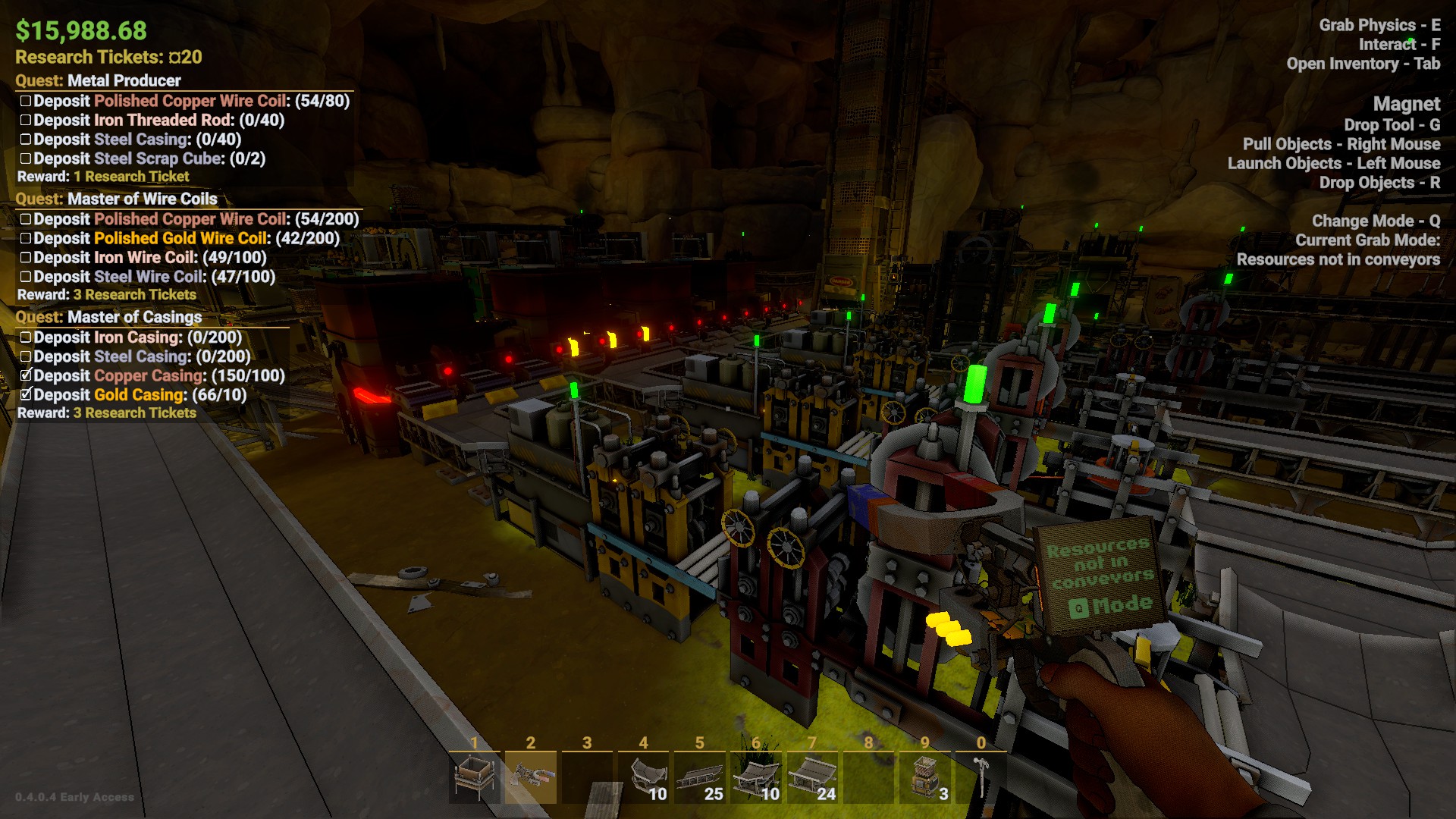
The general gist of Mine Mogul is that you’re in a mine, and you need to put stuff in a drop chute, which then automatically sells it granting you cash to buy more automation tools. More complicated items generate more profit, but are also more complicated to make. Straightforward enough, sure. Then you get to the actual implementation.
When I mention physics, I mean that in nearly all practical gaming senses. Collision & gravity most importantly. Things will bump into each other constantly, and most certainly when on a belt. When things fall off a belt, they hit the ground and you need to manually pick it up to get back to where you want it to be. Practical example now:
In nearly all factory games, you transport items through some sort of belt. Things are placed in an orderly fashion and move at a given rate of speed. If you send 15/minute you will receive 15/minute, not matter how many loops and turns you put on. Here, when you take a turn, the item will collide with any nearby item, and respond appropriately. Larger items may not make the turn and fall off. 15/minute in does not ever mean 15/minute out. In fact, most ‘mergers’ here are actually about dropping items onto a belt and hoping it stays there!
The next big deal here is that all mining activity generates multiple outputs, 3 to 5 items. I am sure you guessed that all processes take 1 item, so you need to filter this output. Filters can only process so many items at a time, and items back up and fall off the belt if so. The only way to combat this is to filter multiple times to multiple belts. Iron and Coal in particular are voluminous, so sub-sorting stations are key!
My typical factory has belts coming in, a sorting station (coal, iron, copper, gold, everything else) to some processing (which is vertically dropped), a smelter which produces ingots, whatever machines I need after that to meet progression requirements, a merged output belt for all types of material, a polisher (dramatically increased value) and then dumps in the chute. Simple in concept, but the practical application requires a lot of trial and error. Which is amazing!
End-game factory.
Depending on the map you choose, you may have a lot of room to build, or very little. I prefer the big option to make large processing floors, but the small one effectively means you get wildly complicated mini-factories that ship out finished products on a very long and winding belt.
There are some QoL bits that I would personally love to see here, most of them relating to logic gates and improved throughput tools. But these changes would reduce the sandbox feel and then get it closer to the standard logistics games I’ve played a dozen times. As for ‘critically beneficial’ improvements, finding a way to get things to the processing chute from across a map would be my larger preference. As it stands, it can take a few minutes to get stuff all the way across the map, so those with some level of logistics experience are likely to find themselves simply waiting for stuff to happen rather than building stuff.
Still, what’s here is frankly a joy to fool around with. You will never ‘mega base’ here, but seeing tons of ore move around a factory with bits falling all over the place is like being in a kid’s playground. Super fun and relaxing!
I’ve had this on my wishlist as a sort of “whatever” game for some time. The Fall sale came by and it was the best deal I’ve ever seen on it, so why not?
I’ll tell you why not. This game is like going to a cheap buffet. There’s stuff for everyone but none of it is any good. Ok, that’s harsh. I’ll give the art and sound some props. It certainly has that Star Wars feel, through and through. That’s about it.
Nix is effectively a contextual menu that changes based on what you are targeting. They are a tool to extend your stealth window. I think it generally works.
Combat is floaty and is clearly an afterthought. This is clearly designed as a stealth game above all else. None of the weapons feel good, grenades don’t do much, and enemies feel like sponges.
Stealth just feels bad. Line of sight make little to no sense. You can knock out enemies mere feet away from others with no impact. And then there are times where you cause a chain reaction of enemies and just plain ol’ die.
The speeder (ground transport) is mostly just exploring an empty landscape with sheer walls to keep you on track. It feels slow and unresponsive.
Upgrades are spread all over the place and feel impossible to track. Why? It’s just fetch quests everywhere.
Space combat…every game in the past 15 years has done better.
Quests are a combination of NPCs randomly strewn about the map, and then a custom-built environment that is made of ladders and tunnels. Rinse and repeat. You’re given no tools or mechanics from the tutorial or beyond to improve the work.
Sabbac is sort of highlight. It flows well enough and you could probably play it at home.
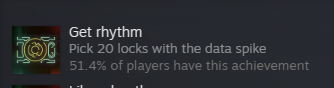
Lockpicking and slicing computers have bad mini games. The first is a rhythm game that doesn’t detect much, and the second is a worse version of Mastermind in every respect. Thankfully you can (and should) disable all mini-games in the menu.
The 3 factions (4 if you count Imperials who will always hate you) are all the same, or at least in any meaningful way. Their rewards are asymmetrical, as only one of them actually allows you to avoid Imperials. The push/pull with them is interesting in concept.
There are 9 experts here, and they unlock additional skills/abilities. Aside from the act of finding them (which is itself a slew of weird quests), all the upgrades are unlocked by activity checklists. Find 10 material, knock out 6 guys, jump across a large gap.
It is a rare thing to play a AAA game that is this bad. And still bad after multiple kitchen sink patches too! What in the world happened to the studio to think this was an acceptable state is beyond me. I honestly feel bad for the devs here, there are so many good ideas that are just poorly executed. Maybe if it had another 9 months in the cooker this could have worked… like actually having the experts offer you quests, or adding more movement stealth tool, or heaven forbid, an actual skill tree.
50% of all players who bought the game unlocked 20 doors. These doors are everywhere, you get this just after the first mission!
Things have to improve from here. They just have to.
In the golden age of point and click adventures, LucasArts was king of the mountain. You could tell it was a LucasArts game just by the art style. Nostalgia is a hell of a drug!
Tell me this isn’t straight of the early 90s!
Puzzle games and adventure games are similar, think Golden Idol for a minute. The difference is failure state. You can, and will die in an adventure game, forcing a restart at some key point. Sierra had notoriously bad failure states where you would have to reset to hours prior. Thankfully we’ve learned a lot of lessons on that front, and games today have you lose a few minutes at most.
The Drifter has all these modern mechanics and trappings, wrapped in a deliciously voice-acted sci-fi story. From the first act, you are slipping between reality and nightmares, trying to find some sense. With 9 total acts to get through, and quite a few puzzles along the way, it’s a solid journey from start to finish. As with many of these games, the logic in some of the puzzles can breakdown if you’re not paying attention… but at no point did I think that a solution was completely bonkers.
The pacing is such that you can either dig through the whole thing in a single sitting, or take 1 chapter at a time. There’s no timer, and the act of gradually unveiling the mystery is quite fun. Thankfully, the twists themselves are also super logical, so no real deus ex machina here.
Give it a shot, well worth your time and money. Can certainly use more games like this in the future!
Satisfactory 1.0 launched in September 2024, 2 years ago. 1.1 came out which focused mostly on QoL items, including improvements on fluids and transport. I’ve done a couple playthroughs now, and do consider the game to be relatively feature complete at this point. Surprisingly, there’s a DLC announced – Core Values.
In some of the news circles, the devs have tried to explain the thinking here. If you compare to Factorio, it’s pretty obvious that the two options are a) find another physical location (Space Age) or b) rebuild the entire production chain (Krastorio). Quite a few logistic games have tried the cave construct, which comes with caveats.
Size. The factory must grow, and games that are architected around tight builds can generally work in confined areas. Games that are built on the concept of size/scale, the size of a location is a major factor. Factorio put temporary limits on land mass size, which you eventually could compensate. Foundry has elevators and caves, which are a right PITA to manage, but generally have ample space to collect items, just not process them. Satisfactory has no real size limits currently, with a very large focus on 3D builds. Very curious as to how this will work.
Logistics. How factories work has been optimized, any new location needs some new logistic tweaks. Satisfactory has horrendous liquid mechanics, so I do hope they don’t mess up there. Driving vehicles are better than before, but still very rough due to clipping. Trains work very well, but need insane space to work. Drones are ideal options in many cases, but obviously won’t work the same way in caves. Belts are apparently going to be tweaked. I’d gather there’s some limiting factor here with a new transport mechanic required.
Production Chains. The current game has you producing teleportation and quantum power. I’m not quite sure what could come on top of that, but there certainly is an option for some mid-game changes, which begs the question ‘At what point does the expansion take place?’. I’m sure there’s some integration with max-level factories, but is this something that goes into Tier 2 production? Will it impact that construct?
Space Elevator. The game is wrapped around the concept of shipping things to space, not sure a space elevator works underground. So does production require shipping between surface/caves, or is it a separate system? I’d certainly assume the former.
I do think this is an odd choice of DLC, likely limited by the game engine. I mean, the whole point is to build a space ship after all, and you do that. It would seem a potential option to unlock other planets or locations, rather than a space-limited construct. And space-limited with a game engine that does NOT support a destructible world.
This does pique my interest, as Coffee Stain has a good track record on building cool things and integrating player feedback. And really, Satisfactory is a top-tier option in the logistics space. More of that is certainly a good thing!
Factory automation and a skinner box? Let’s give it a go. Free demo, why not?
The main concept here is that you want to empty the pile of hay, 1 strand at a time. In that pile are 6 needles that provide absolutely atrocious buffs, but acts as a sort of meta-badge I guess.
You start as all automation games do… manually. It takes about 60 minutes before you can truly start automating anything. It takes even longer before you complete the 10 delivery quests that unlock all the available tech.
Progress is gated through money, there are no building materials or anything complex here. You need cash to build machines. You need cash to build belts. You need cash to build power stations. You need cash to upgrade machines. You need cash. And the best source of cash quickly becomes obvious as paper mills.
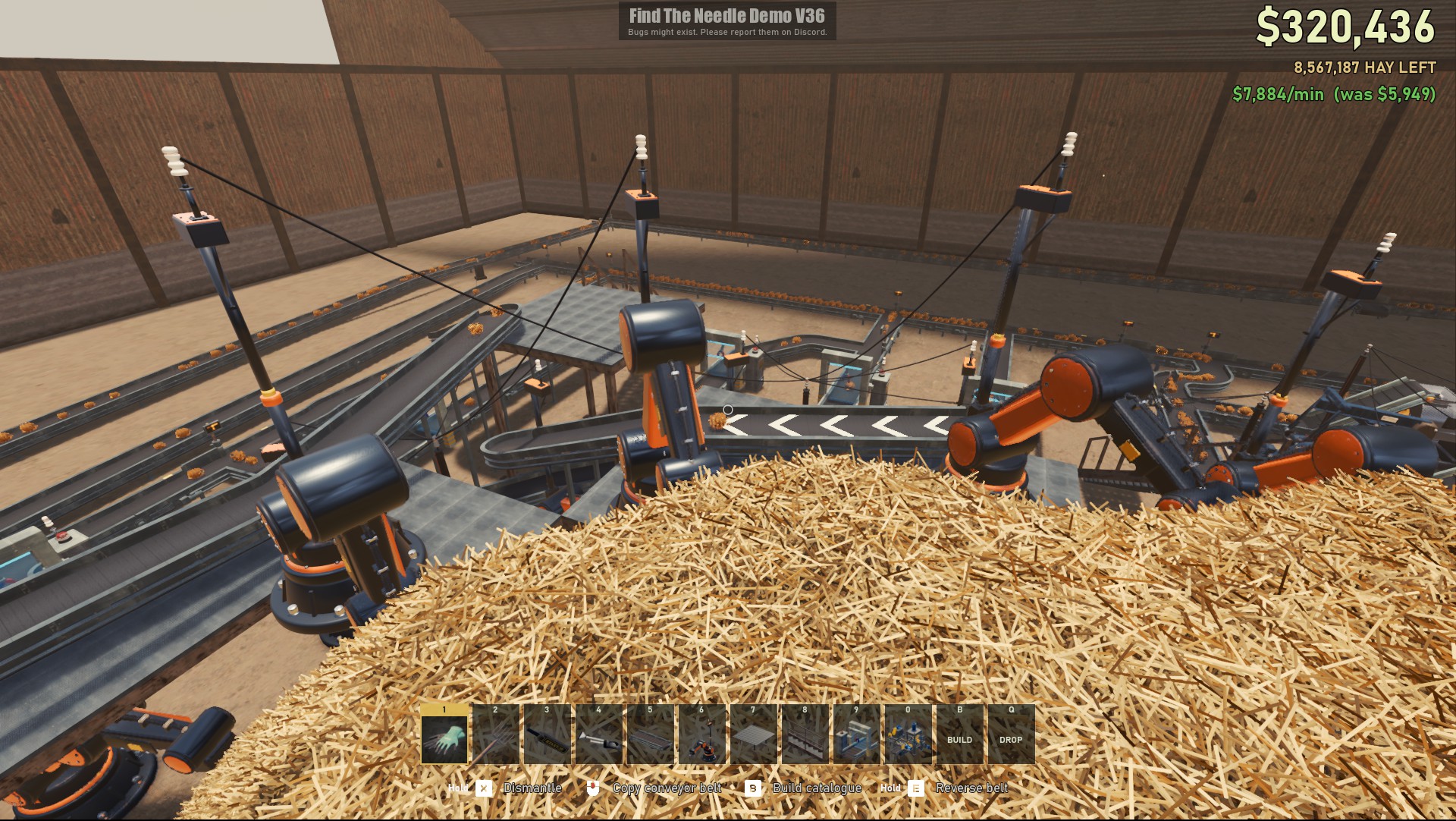
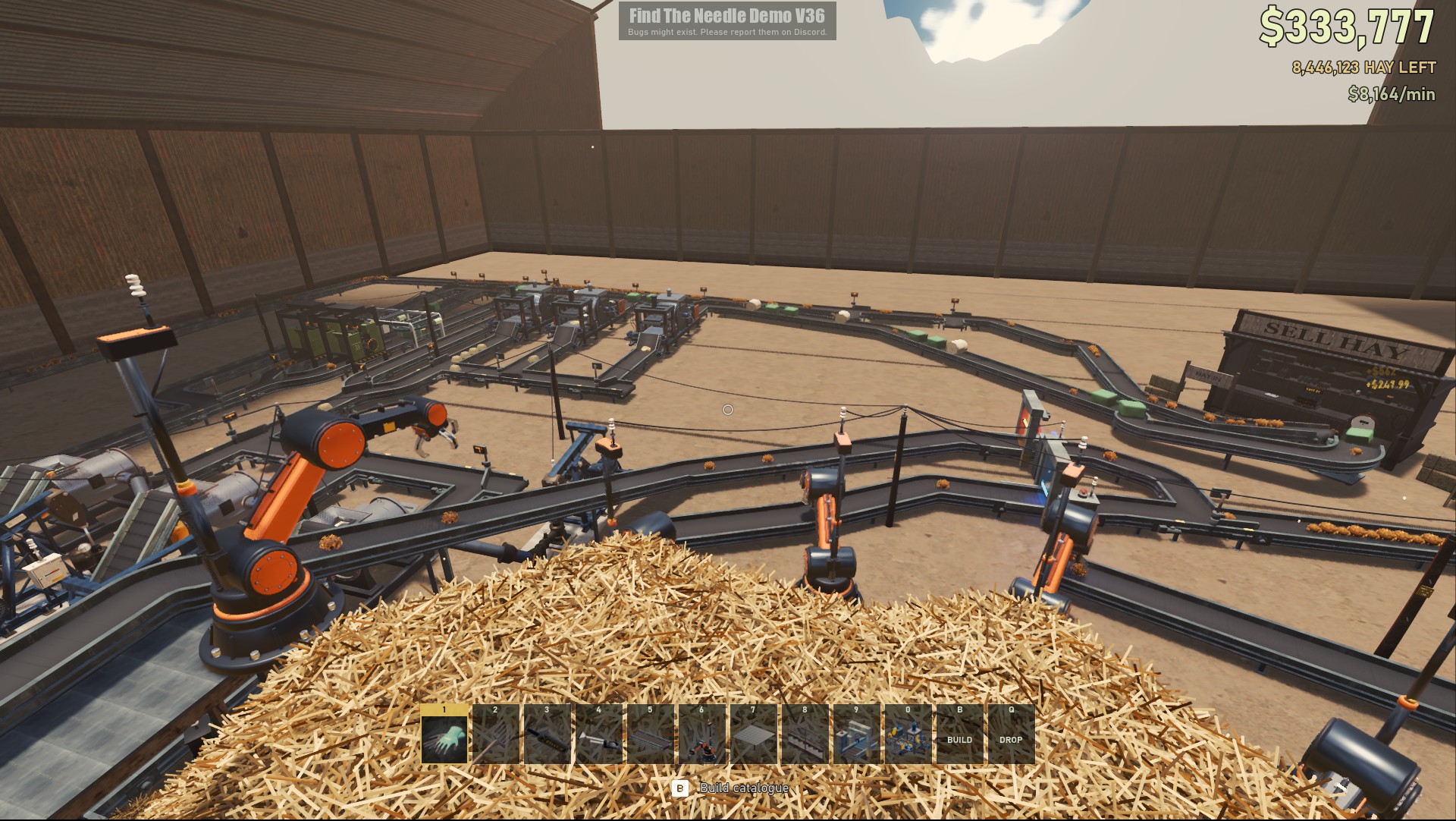
Eventually you do realize that you no longer need cash, you need throughput. At max level, each arm can extract about 3,500 strands of hay per minute (if there’s hay in range). That’s about 48 hours to eliminate 10,000,000 hay. You need a lotta arms! Which then fill your belts with hay, which also get saturated. The belt merging causes a slight hiccup in throughput, actually slowing things down. Oh, and to find the needles, you need to scan the hay, with 1 scanner per 2 arms.
The end result is a massive spaghetti run of belts, mergers, producers and power poles. Did I mention that there’s collision detection? That then means you need some 3D magic to make it all work together.
The two images below have maximized the number of arms possible (again, due to collision) at about 20. There’s 8.5m hay to go. That’s 2 hours, at best, to get to the bottom. The reality is that the arms will need to be moved closer together as the pile shrinks. I generally dislike AFK automation games, and there’s really nothing left to build now, just waiting. So I guess for all intents and purposes, I’ve completed the demo. It’s a neat idea, with a ton of rough edges. Free demo though…
Logistics games work on a rather simple concept. Insert material into a machine, extract the results. The complexity lies in the amounts of those 3 items, and their relationships. End-game factories have dozens of production lines to keep track of. The unique aspect of each of these games tends to lie with mass-distribution mechanics – moving things. Some use robots for low volume/high frequency, some use belts for a medium view, some trains for mass transport, and some ships for large distance transport where trains cannot work, normally providing less material than a train would.
DSP has robots, belts, and ships. It does not have trains.
Robots are used extremely sparingly, primarily for keeping your personal inventory filled with buildings, but also in support of uncommon building requirements on a bus.
Belts maximize at 60 items per second, which is only truly impactful in base ore processing. 20 smelters will saturate a belt. Stacking / piling is different (more on that in a bit.)
Ships have 2 types, local and between planets.
Local has some small limits that can be improved through research, and are generally effective at large scale transport on a given planet.
Planet shipping is slightly more complex, as the time it takes to ship can be long, especially when travelling between systems. Large factories require dedicated off-world shipping, which then distribute locally.
Small Scale
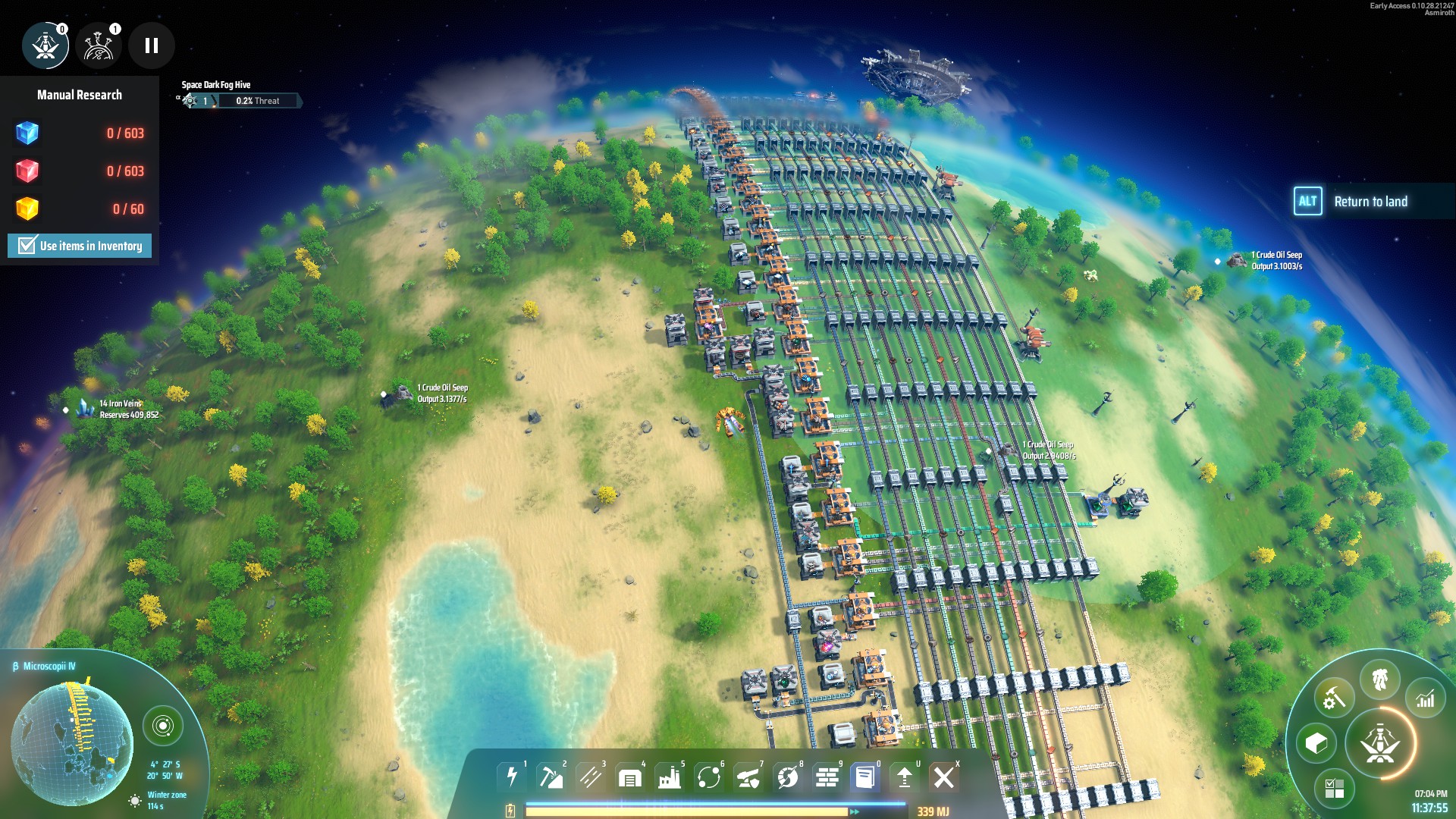
Until you unlock the ability to use ships, nearly everything is managed through belts. Throughput is low, a main bus can ship things effectively between buildings, and it generally keeps power usage low. The downside is that a significant amount of material is located on the belts at any time. Noting that this period also includes you travelling to another planet for silicon + titanium, smelting it there, and manually hauling it back to your main base.
“Simple” starter planet main bus.
Planetary Scale
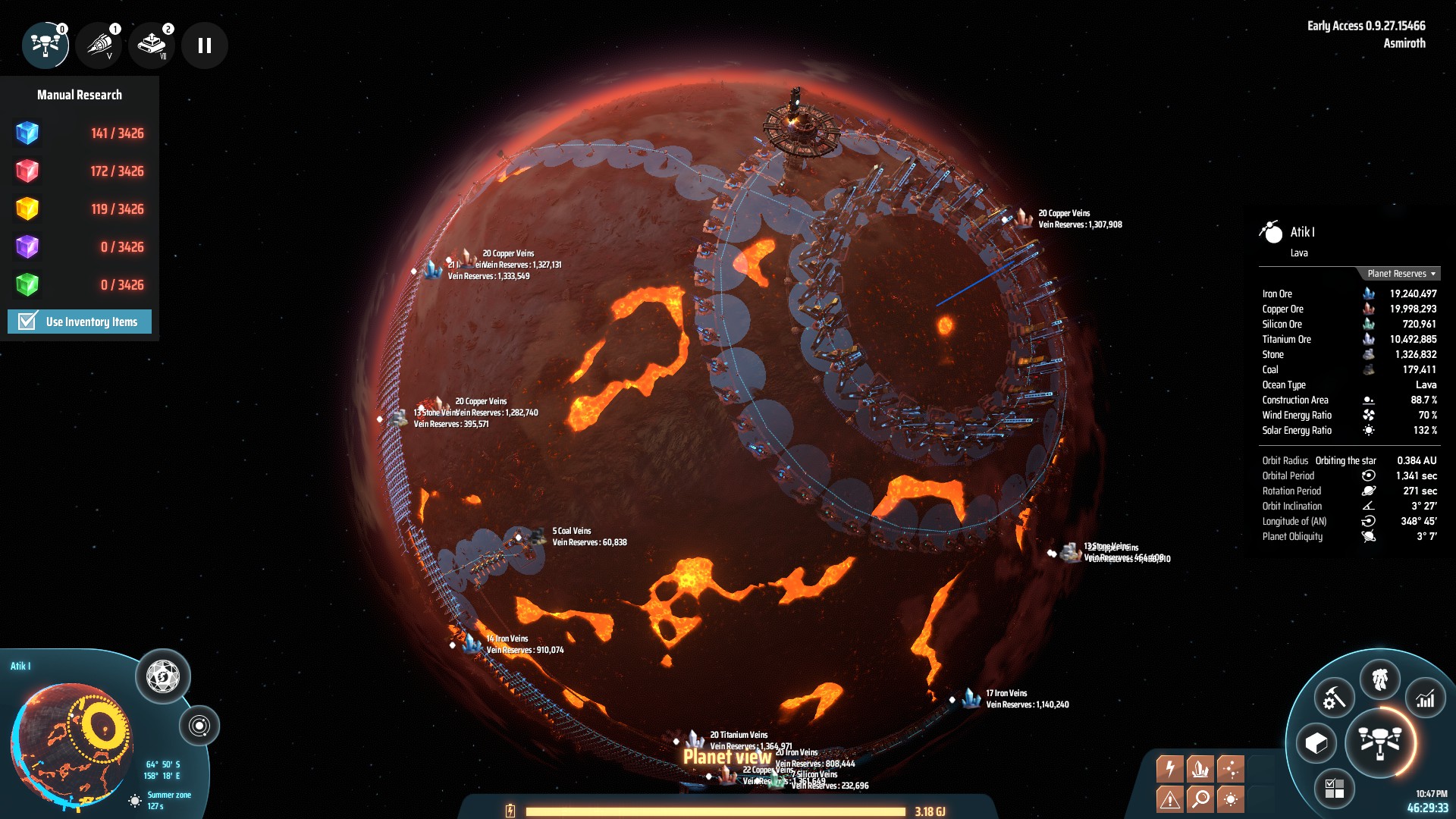
When you do unlock ships, you’ll want to immediately move to the non-lava planet in your system. Some basic power options will be laid out, and you’ll focus on the basic smelting lines, effectively replicating all items on your starter planet here instead. That means all material up to yellow science.
Power is a massive issue here, as all logistic towers require an insane amount to charge, and you’ll be starved quickly. You’ll also have few ships available for distribution between towers, maybe 5 local and 1 planet per. That’s a start though, and enough to rebuild a main bus on this planet. Keep the starter planet running until you unlock purple science!
The power issue is going to be addressed by 2 methods. First, put as many wind turbines as you can on each pole, it will take a few hundred for sure. Next, on the lava planet, you’ll need to build a charging station, which requires a combination of wind/solar power and a battery construction plant. Use the extra power to charge batteries and ship them to your factory planet for discharge. Ship the empty batteries back. It’ll take a bit to build up, and charge rates are entirely related to the amount of excess planetary power… so keep improving it here. Eventually, you can supplement it with Deuterium Rods. Unfortunately, these batteries will be the only viable option until you get a Dyson Sphere running.
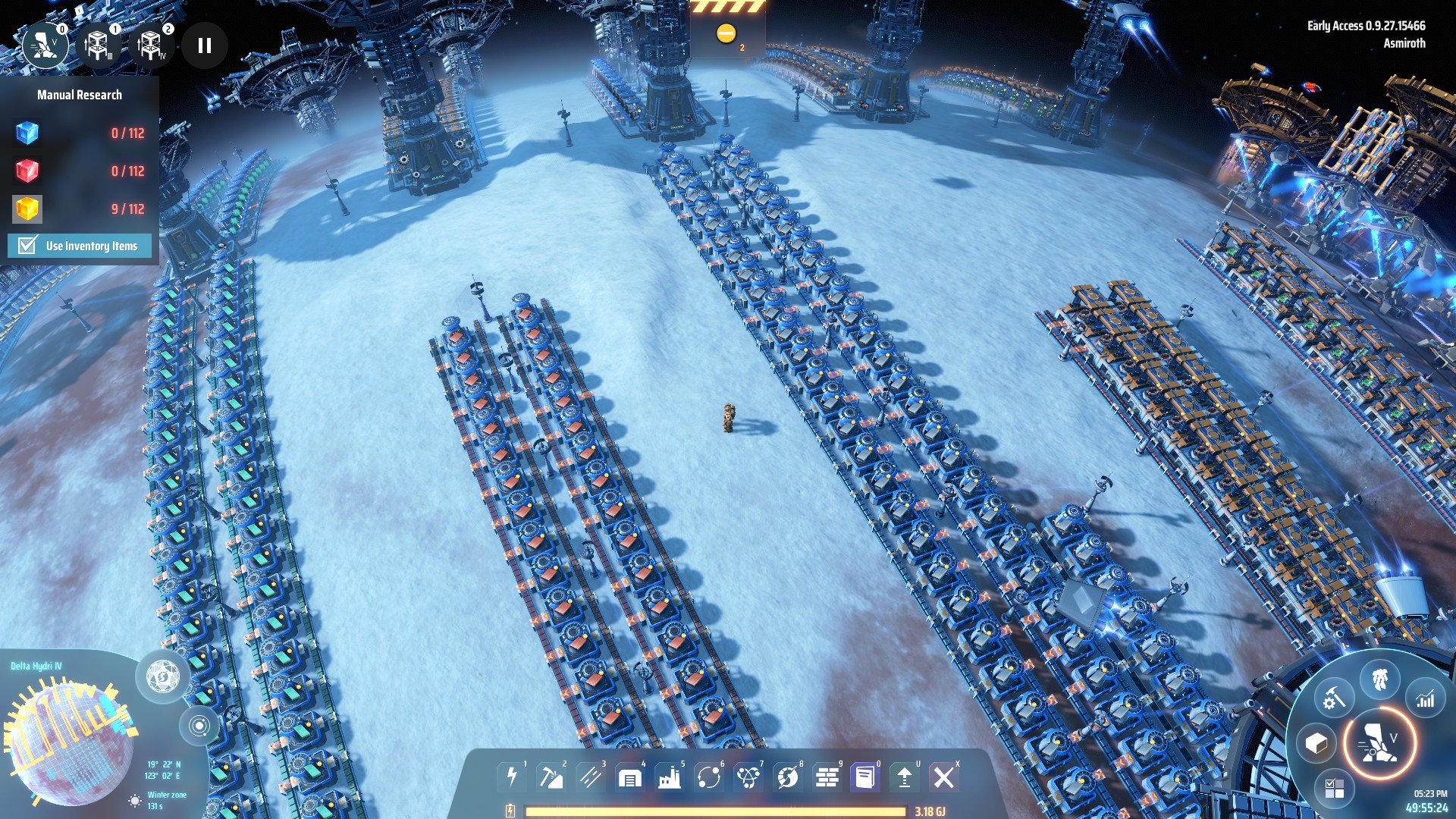
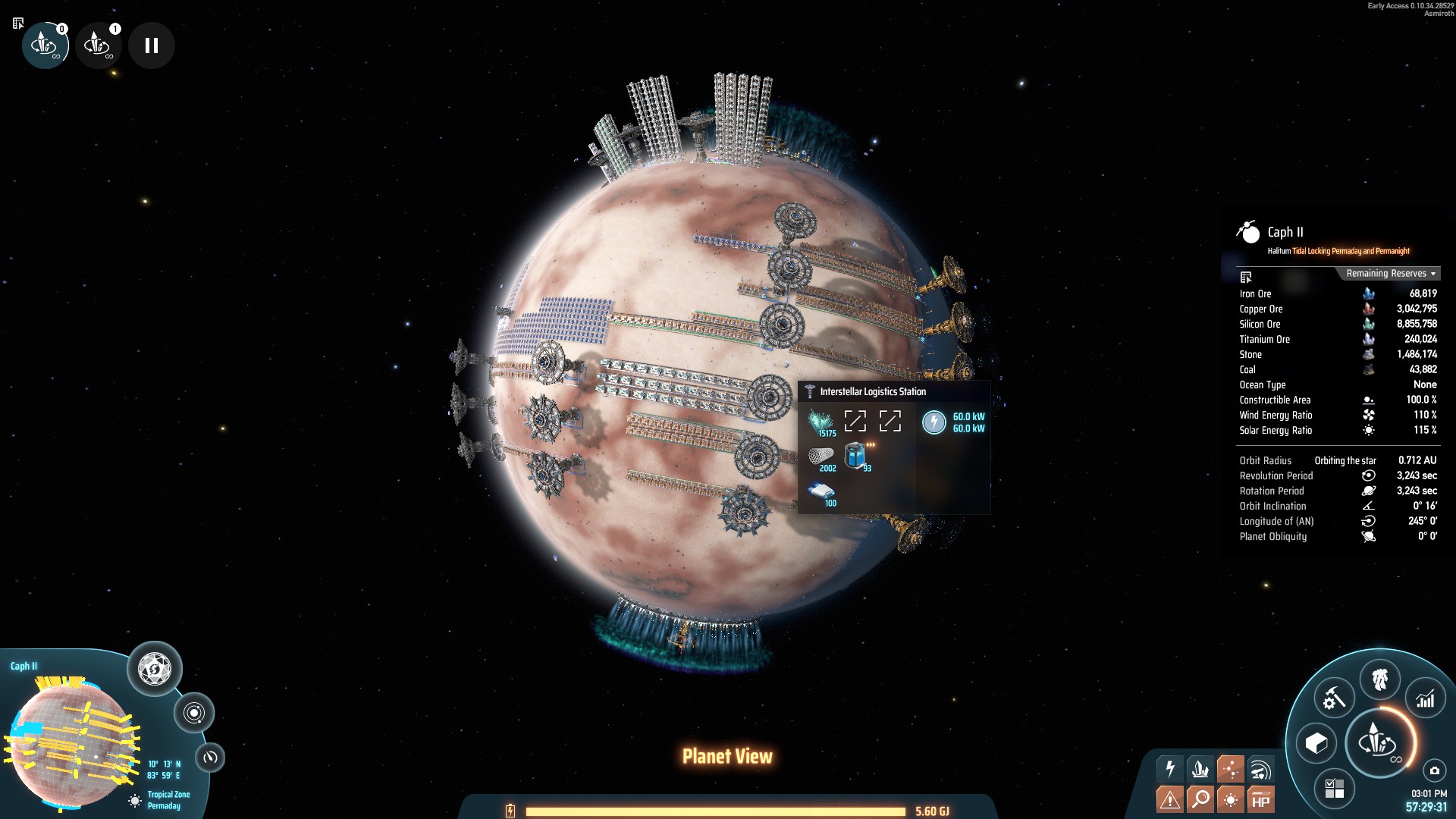
A lava planet with an equator of solar panels (for battery charging), deuterium processing, and rocket silos.
Proliferation
This is analogous to beacons in Factorio or Sommersloop in Satisfactory – they boost your output costing significantly more power. Mk1 sprays only cost Coal, and you should proliferate every single item (except raw ore, fuel, and dyson sphere components), including the spray itself. Make Mk3 spray once you unlock additional planets, as the nanotubes required need rare resources. Same rules. The 25% bonus to output is massive on multistep chains, which means you need less buildings, and therefore less power.
Easily scaled proliferation Mk3 plant. I keep Mk1 in storage for emergency purposes.
Interplanetary Scale
This happens when you start collecting rare resources outside your main system (kimberlite ore, sulfuric acid, and unipolar magnets all require level 4 exploration). These rare resources require warpers (green science) to move between systems, and dramatically simplify production chains. You can’t scale without these, and likely will need 1 dedicated logistics tower per.
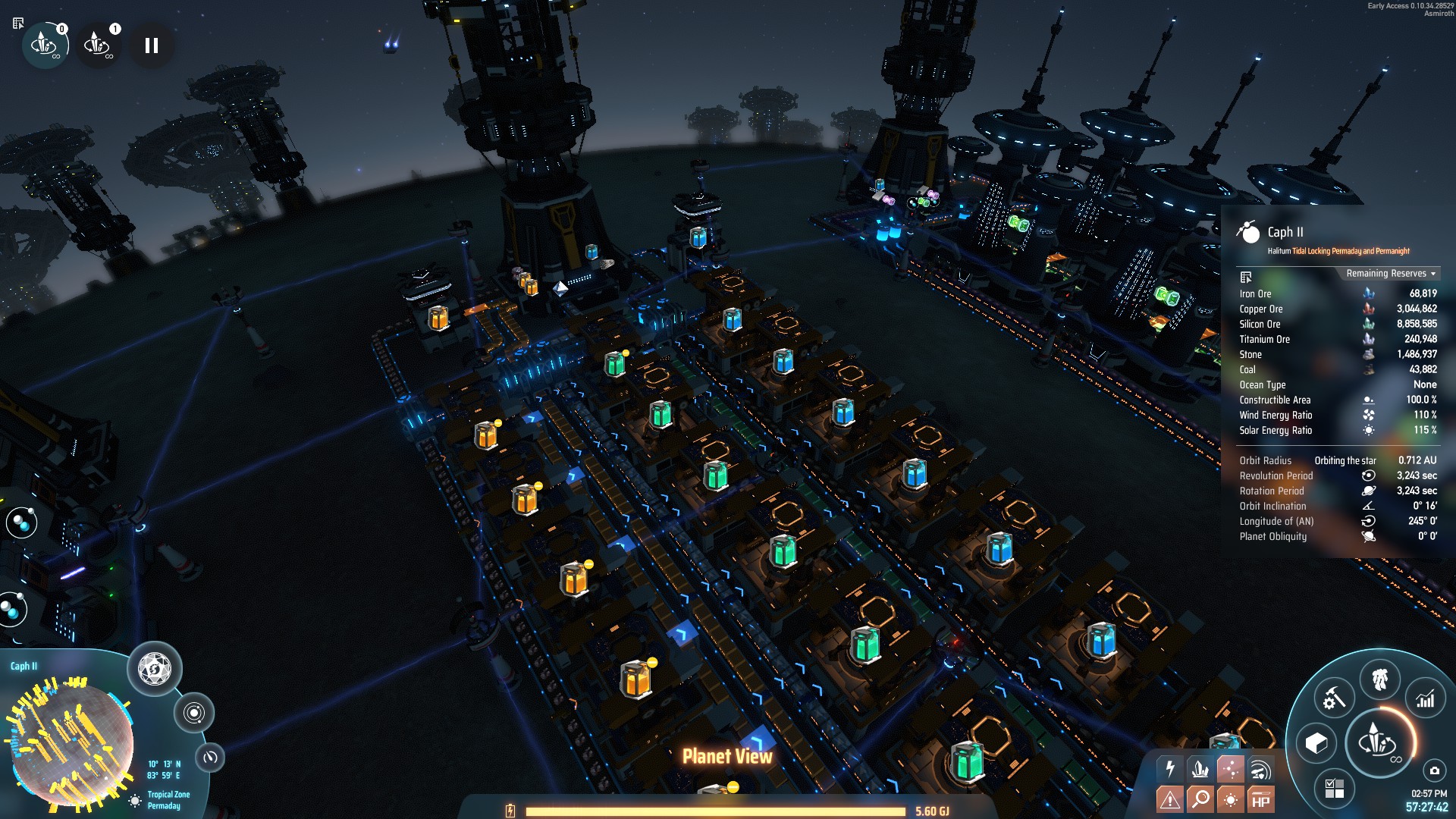
You’ll likely build a dedicated manufacturing channel per item as well. Why? Because this is the only effective way to build a modular design that can scale to meet Dyson Sphere requirements. If you build a self-contained red engine plant, eventually you’ll need 8x more of it. It is much easier to lay down more belts and assemblers than to lay out an entire new blueprint. Further, each logistics tower can only accommodate 5 items in storage, or seen differently, the end product cannot require more than 4 ingredients per tower. Excepting white science, this isn’t an issue if you dedicate 1 tower per product. Complex builds will require multiple towers, which a) costs a LOT more power, and b) you have to build them a certain distance apart from each other. Modular builds ftw!
This modular design (20 spaces each) allows for a ton of room to expand each item processing.
There are 3 main exceptions to this however. First, your main bus will have 5 towers to feed all the base material. Anything that is used in 4 or more buildings should be in the bus, the rest you can robot in. Second, your main construction material (inserters, belts, assemblers) should be in a concentrated build. It’s 3 towers of material to build level 1 through level 3 items. Extremely worth it. Third, proliferators. You will build Mk1, Mk2, and Mk3 items from the same tower, as it only requires 3 main ingredients and you will blow through them too quick to use ships. It’s only 1 tower mind you, but a very compact build.
Smelting Math
A Mk3 belt can support 30 items a second (1,800 per minute). That seems a lot, and for a decent part it is. A basic smelter takes 1 ore and gives 1 ingot per second. 30 smelters = a full belt. Cool.
Plane Smelters works 2x as fast, Negentropy Smelters (only with Dark Fog) are 3x. Your belt can neither feed in nor out that volume. Enter stacking, and two options, one of which is false.
Pilers take items on a belt and stack them. To get to 4 stacks, you need 4 pilers. You should never use pilers, ever. Pile Sorters are the right answer, through a relatively simple upgrade that automatically inserts and extracts up to 4 products. They take a lot of power, but they are better in almost every other way.
Noting that advanced logistics research (12k+ white science, multiple times) is required for logistics stations to automatically stack outputs. You want this.
Mega Basing It
So here’s the kicker that you eventually realize, there are only 2 main outputs of any given base, components for the Dyson Sphere (rockets + sails) and research, and you need 3 or more orders of magnitude less rockets than sails. If you want more than 1 sphere, then you’ll need to ship the material to another system, and build the relative ray receivers. I do not recommend this.
This is a 300SPM base. The Carbon Nanotubes are 75% full in their lane, with 33 Mk1 Chemical Plants. 1,000 SPM will require 54 Mk2 Chemical Plants. 33% more productivity, 80% more power.
What you’re left with is the chase for more SPM, which is rate limited based on critical photon generation from ray receivers. It is unlikely you will hit that particular limit mind you, as you there are other key pieces along the path that you need to scale at late game. This assumes you have all stacking options unlocked (you want this for the recipes needing 12 Hydrogen per craft)
Deuterium. Used for Strange Matter, you need a ton of this. A gas giant helps a lot here, more than one is better. Otherwise you need to make it from Hydrogen. You need a LOT.
Plane Filters. The materials are easy enough to find, but it takes a lot of assemblers to make enough. This is likely where you will first use Mk3 assemblers.
Carbon Nanotubes. You need these for so many things and will absolutely tear through production area doing so. Mk2 Chemical Plants are needed here first. The compression rate (6:1) should incentivize you to craft this on the planet where you harvest Spiniform instead.
For high SPM builds, you will want to dedicate other planets to specific research outputs. This will mean shipping Artificial Stars to get power running, fuel, and Mk3 proliferators on a regular basis to keep it running.
Blue requires copper + iron. Very easy. All planets can do this.
Red requires coal + hydrogen. Coal is generally limited to specific planets. Hydrogen you want from a gas giant. The starter planet + system is a good option, though there are plenty of others.
Yellow requires titanium and organic crystals. No single planet will have both, so select a system with the latter and use 2 planets.
Purple is a pain. You need rare resources. Fractal Silicon, Oil, Water, Fire Ice, and Spiniform Stalagmite Crystal. There are a dozen or so systems that meet this need. You’ll need to harvest from multiple planets, and be located on the one with Oil/Water.
Green requires a lot of Deuterium, Grating Crystals, Fire Ice, Water, and Kimberlite Ore. There are not many systems that fit this bill – not sure if I’ve ever actually seen one that has Crystals and Ore together. Given you need Graviton Lenses for your Dyson Sphere collection, I would build this on the starter planet and just ship in the base mats.
White requires antimatter, which can only be refined within a Dyson Sphere system, so no real options here.
It is entirely possible to hit 5k SPM on a single factory planet. It isn’t ideal, but is certainly feasible.
I gave this a shot a year ago, in EA. Last week it hit 1.0, which brought mostly mid-/end-game activities to the table. Pretty obvious I’ve played my fair share of simulation / logistics games and this one still fits that general bill.
Right, to the point here. The start of the game is poorly paced. The tutorial does a good job of explaining the basics, but then you get into the meat and potatoes of it, which is as slow as molasses. Early on, you’re given a quest to prepare your base for the arrival of stranded space folk. To to this, you need to complete about 20 steps and have the ability to pump out an absurd number of materials to construct it all. To use my previous buffet analogy, you are shown all the options, but can only order soup. And you better like that soup, cause it’s all you’re gonna get for 4 hours.
This is an unfortunate design choice as I can’t see too many people sticking around that long watching 1 tile at a time be constructed. Once you get to the actual factory building part (multi-regolith processing), the game actually becomes an interesting balance between production and advancement. You have, generally, meaningful decisions to make and prioritize to have the game move forward. This is what a good game should focus upon.
It’s a better game than it was a year ago and brings some interesting items to the table. It just happens to have one of the worst extended tutorials I have ever played. A tutorial that would easily be remedied by providing you the construction material to build the quest requisites. Then you’d get the right amount of taste for the systems and make a better choice. Hopefully this 1.0 launch gives them that feedback.